Admin
Admin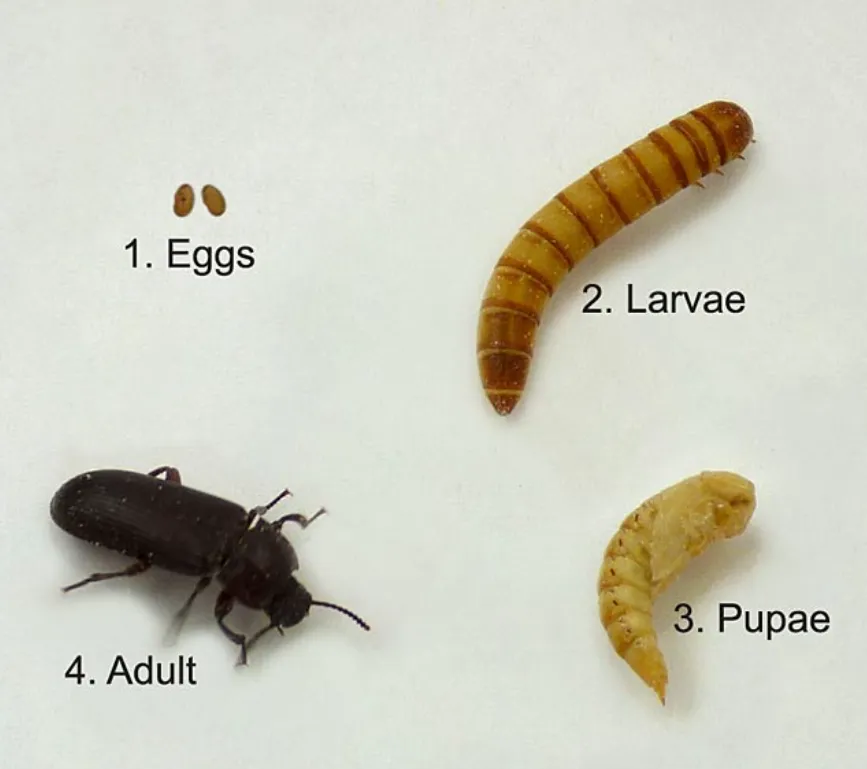
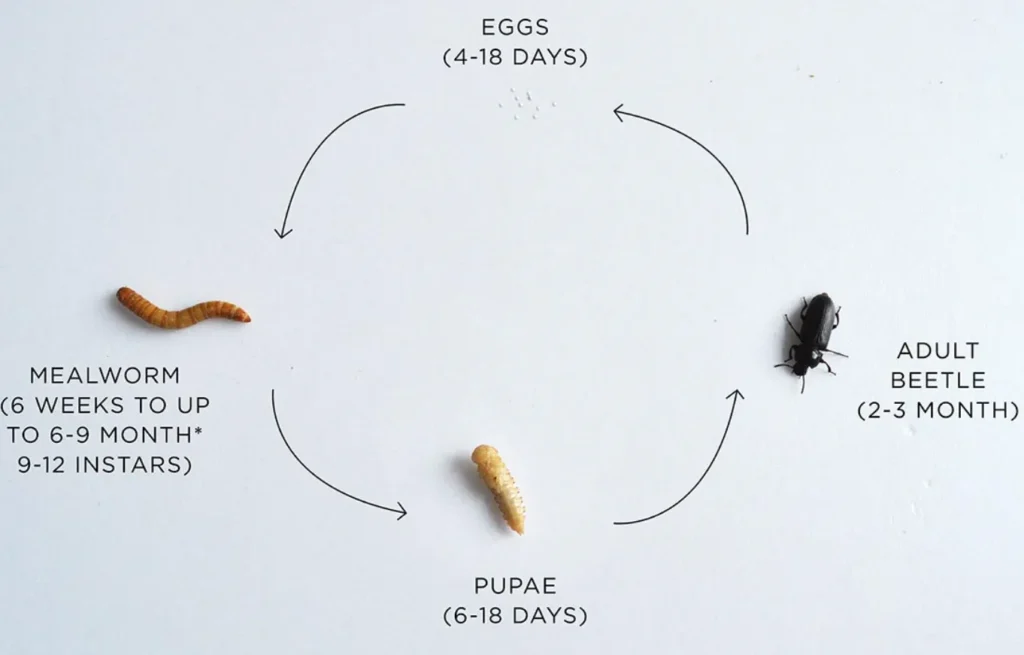
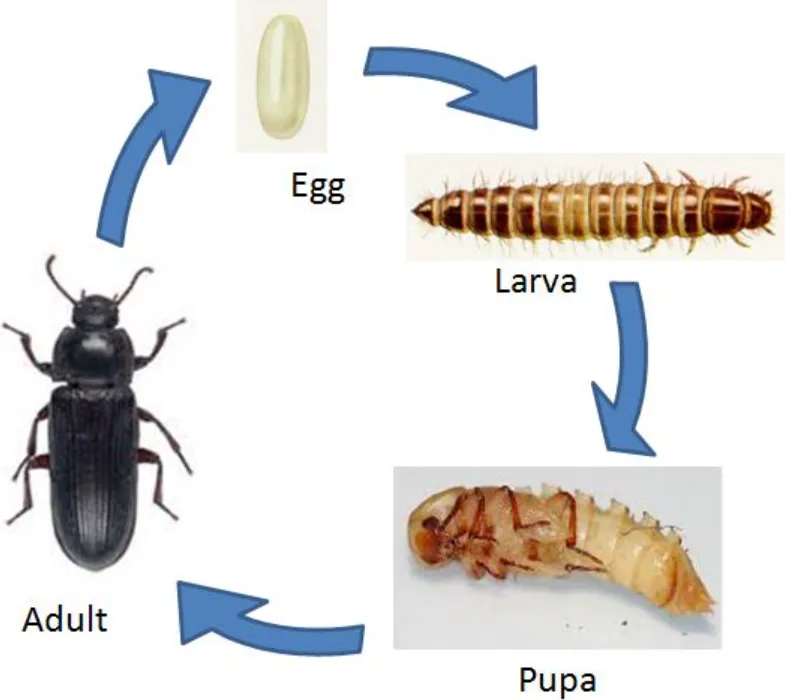
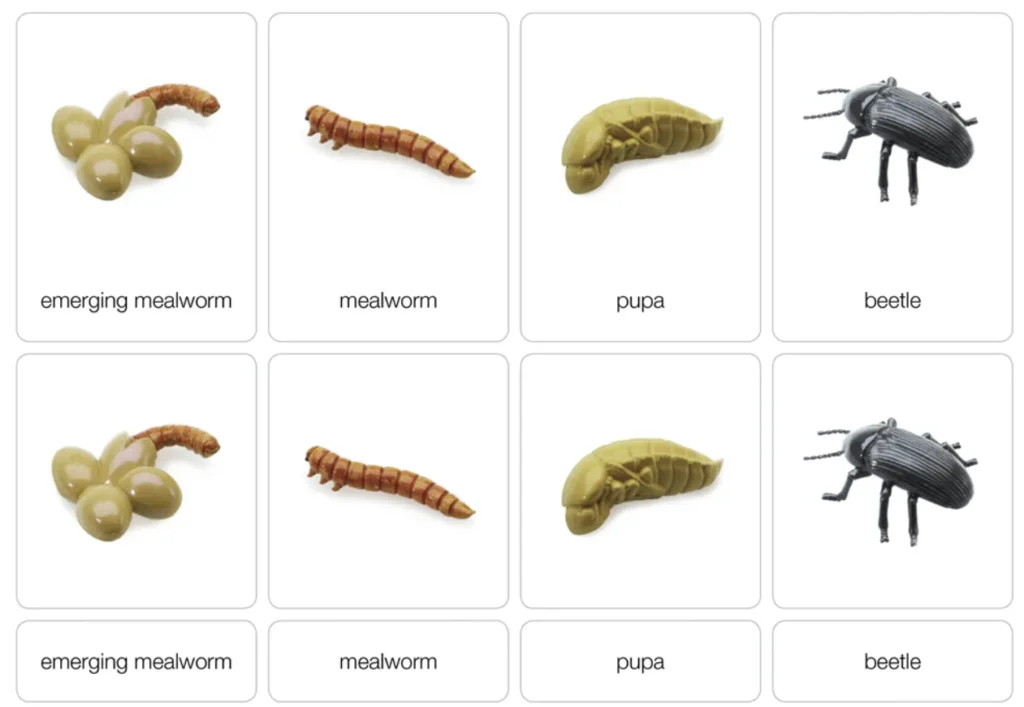
The darkling beetle life cycle is one of the best examples of complete metamorphosis in insects. A darkling beetle begins life as a tiny egg, becomes a worm-like larva, transforms into a resting pupa, and finally emerges as an adult darkling beetle. This four-stage development makes the insect easy to study in classrooms, farms, laboratories, and natural ecosystems.
Darkling beetles belong to the family Tenebrionidae, one of the largest beetle families in the order Coleoptera. This family includes more than 20,000 species, many of which are adapted to dry, dark, hidden environments. Some live under rocks, in bark, leaf litter, fungi, stored grains, in barns, in poultry houses, and in desert soils. Many species are harmless scavengers, while others are known as stored-product pests because their larvae feed on dry grains and flour.
Q: What are the stages of the darkling beetle life cycle?
A: The main stages are egg, larva, pupa, and adult beetle.
Q: What is a darkling beetle larva called?
A: Many darkling beetle larvae are commonly called mealworms, especially the larvae of grain-feeding species.
Q: How long does a darkling beetle live?
A: The darkling beetle’s lifespan varies by species, food, temperature, and habitat. Some develop quickly in stored grains, while others develop slowly and may live as adults for about a year or longer.
Quick Life Cycle Table
| Life Cycle Stage | What Happens | Key Features | Approximate Timing |
| Egg | Females lay tiny eggs in soil, grain, litter, or protected substrate | Small, pale, hidden, vulnerable | Depends on species and temperature |
| Larva | The egg hatches into a worm-like larva | Known as darkling beetle larvae or mealworms in many species | Often, the longest feeding stage |
| Pupa | Larva stops feeding and transforms internally | Soft, pale, inactive, non-feeding stage | Can last from days to weeks, depending on conditions |
| Adult | Mature beetle emerges and reproduces | Dark body, hard wing covers, and nocturnal habits in many species | Some adults live months; some species live longer |
This table gives a simple view of the darkling beetle life cycle, but each stage can vary widely. Temperature, humidity, food quality, crowding, and species type all influence development speed.
The History of Their Scientific Naming
The scientific name of the darkling beetle is Tenebrio. This name is derived from Tenebrio, a genus described by Carl Linnaeus in the eighteenth century. The word Tenebrio is often explained as meaning a seeker or lover of dark places, which fits the nocturnal, hidden habits of many species. The English name darkling beetle also reflects this dark-loving behaviour.
The term does not mean that every darkling beetle is active only at night. Some species can be active during the day, especially desert-adapted beetles. However, many darkling beetles avoid bright light and prefer protected places such as bark, soil, crevices, leaf litter, and grain storage areas.
Scientifically, darkling beetles are classified as:
- Kingdom: Animalia
- Phylum: Arthropoda
- Class: Insecta
- Order: Coleoptera
- Family: Tenebrionidae
This naming system helps scientists distinguish darkling beetles from other beetle groups and understand their ecological roles, evolution, body structures, and behaviours.
Their Evolution And Their Origin
The origin of darkling beetles is linked with the long evolutionary success of beetles. Beetles are among the most diverse insect groups on Earth, and Tenebrionidae became especially successful because many species adapted to dry, hidden, nutrient-poor, or decomposing environments.
The fossil record shows that darkling beetles have a deep evolutionary history. A fossil review of Tenebrionidae identified more than 100 species. It noted significant fossil diversity from the Lower Cretaceous of China, Paleocene deposits of France, Eocene, and Miocene amber.
Their success is partly connected to their flexible feeding habits. Many darkling beetles survive as scavengers, feeding on dry plant matter, fungi, dead insects, animal remains, or stored grains. This flexibility allowed them to occupy deserts, forests, grasslands, caves, farms, barns, and human storage systems.
Desert species are especially interesting. Some darkling beetles have hard outer bodies that reduce water loss. Others hide during hot daylight hours and move at night when temperatures are lower. Some desert species can even use fog or environmental moisture, showing how well they have adapted to extreme habitats.
The darkling beetle’s life cycle also helped its survival. Complete metamorphosis allows larvae and adults to use different resources. The larva focuses mainly on feeding and growth, while the adult focuses on dispersal, mating, defence, and egg-laying. This separation reduces direct competition between early and adult stages.
Their main food and its collection process
Darkling beetles are highly flexible feeders. Both adults and larvae have chewing mouthparts, which allow them to break down dry or decaying materials. Many species are scavengers that feed on plant debris, rotting wood, fungi, dead insects, or animal tissue. Others feed on living plants, seeds, stored grains, flour, cereals, rice, dry pet food, and poultry feed.
Their food collection process is simple but effective:
- Searching in dark places: Many adults move at night or under cover to find food while avoiding predators.
- Burrowing through substrate: The darkling beetle larva often moves through grain, soil, litter, or decaying material to feed safely.
- Chewing dry matter: Larvae and adults use strong mandibles to chew plant fragments, fungi, seeds, and other organic matter.
- Using stored food environments: Some species enter barns, kitchens, mills, or grain stores where dry food is available.
- Feeding slowly but continuously: Larvae often spend a long time eating and molting before becoming pupae.
Some species are beneficial because they recycle dead organic matter. Others become pests when they spoil stored grains or animal feed. In homes, beetles found in flour, cereal, pasta, dry pet food, or birdseed usually indicate a stored-product infestation.
This feeding habit is the reason darkling beetle larvae are both useful and problematic. They are raised as food for birds, reptiles, amphibians, and fish, but they can also damage stored food when populations grow unnoticed.
Important Things That You Need To Know
The darkling beetle life cycle is closely connected to several important search terms and biological facts. First, the darkling beetle is not one single species; it is a common name for many species in the family Tenebrionidae. This means body size, colour, lifespan, habitat, and behaviour can vary widely.
Second, darkling beetle larvae are often called mealworms, but not all mealworms are darkling beetles. The popular yellow mealworm, Tenebrio molitor, is only one well-known example. It is widely raised as animal feed and used in biological studies because it is easy to handle and observe.
Third, a darkling beetle bite is usually not a serious concern for people. These beetles are not aggressive toward humans. Some may pinch lightly if handled roughly, but their stronger defence is often to hide, play dead, or release unpleasant-smelling secretions.
Fourth, darkling beetle eggs are small and often hidden in soil, litter, grain, bran, or other protected substrate. Because they are tiny, people usually notice the larval stage before they ever see the eggs.
Finally, darkling beetle size varies widely among species. Some adults are only a few millimetres long, while others are much larger. Britannica notes that adult darkling beetles can vary greatly in size and shape, with some species ranging from very small to over 30 mm in length.
Their life cycle and ability to survive in nature
Egg Stage
The egg stage begins when the female lays eggs in a protected place. Depending on the species, eggs may be placed in soil, leaf litter, grain, bran, rotting wood, fungi, or animal housing material.
The eggs are usually hidden because they are vulnerable to drying, predators, and disturbance. A good moisture balance is important, but too much moisture can promote mould and disease.
Larval Stage
The larval stage is the main feeding stage. This is when the insect grows quickly and stores energy. Many larvae are long, cylindrical, brownish, and hard-bodied. These larvae are often called mealworms or false wireworms.
The larva molts several times because its hard outer body cannot stretch. After each molt, the larva becomes larger. Food quality, temperature, and crowding affect how fast this stage develops.
Pupal Stage
The pupa is the transformation stage. The larva stops feeding and becomes mostly inactive. Inside the pupal body, tissues reorganise, and the adult beetle form develops.
The pupa may look soft, pale, and curved. Although it appears inactive, a major biological change is happening inside.
Adult Stage
The adult beetle emerges after pupation. At first, it may appear soft and pale, but its body later hardens and darkens. Adult beetles seek food, shelter, mates, and egg-laying sites.
Their survival ability comes from their hard body, dark colour, hiding behaviour, nocturnal movement, flexible diet, and defensive habits. Some species can also survive in dry habitats where many insects struggle.
Their Reproductive Process and raising their children
Darkling beetles reproduce sexually. Adult males and females mate after reaching maturity. After mating, the female lays eggs in a suitable substrate where larvae will have access to food after hatching.
Their reproductive process usually follows these steps:
- Mate location: Adults find each other through movement, contact, chemical cues, and suitable habitat conditions.
- Mating: Male and female beetles pair, and sperm is transferred to the female.
- Egg laying: The female places darkling beetle eggs in hidden areas such as grain, bran, litter, soil, or organic debris.
- Larval independence: After hatching, larvae begin feeding on nearby material without parental care.
- Molting and growth: Larvae pass through multiple molts before pupation.
- Pupation: Mature larvae move into a safer location and transform into pupae.
- Adult emergence: New adults emerge, harden, darken, and eventually reproduce.
Darkling beetles do not raise their young as mammals or birds do. There is no nursing, guarding, or feeding of offspring by parents in most species. Their “child care” is mainly indirect. The female chooses an egg-laying site that gives the larvae food, shelter, and protection.
This strategy is efficient because females can produce many eggs, and the larvae are built to survive independently. In natural systems, many eggs and larvae are lost to predators, dryness, disease, or poor food conditions. The species survives because enough individuals complete the life cycle and become reproductive adults.
The importance of them in this Ecosystem
Natural Decomposers
Darkling beetles are important decomposers. Many species feed on dry, dead, or decaying plant material. By chewing and breaking down organic matter, they help return nutrients to the soil.
This role is especially important in dry habitats where decomposition can be slow. Their feeding activity supports nutrient cycling and soil health.
Food for Other Animals
Birds, reptiles, amphibians, mammals, spiders, and other insects eat darkling beetles and their larvae. Their presence supports food webs in forests, grasslands, deserts, farms, and gardens.
Mealworms are also commercially raised as food for pet reptiles, birds, amphibians, and fish. This shows how the same insect group can be ecologically and economically important.
Soil and Habitat Health
By moving through soil, litter, fungi, and decomposing material, darkling beetles help mix small organic particles. Their movement creates tiny spaces in the substrate and supports microbial activity.
They are not as famous as earthworms, but they still contribute to the hidden work of ecosystem maintenance.
Scientific and Educational Value
The darkling beetle life cycle is widely used in education because students can clearly observe complete metamorphosis. The transformation from larva to pupa to adult is simple, visible, and biologically meaningful.
Some species are also used in laboratory research related to behaviour, heredity, ecology, nutrition, and insect development.
Pest and Management Value
Not all darkling beetles are beneficial in human spaces. Some species damage stored grains, flour, poultry houses, and dry food products. Understanding their life cycles helps farmers, homeowners, and food storage managers control infestations safely and effectively.
What to do to protect them in nature and save the system for the future
Darkling beetles are small, but they contribute to healthy ecosystems. Protecting them means protecting soil, decomposers, and natural food webs.
- Protect leaf litter and natural ground cover: Avoid removing every fallen leaf, twig, and piece of organic matter from gardens or natural areas.
- Reduce unnecessary pesticide use: Broad-spectrum insecticides can kill beneficial beetles along with harmful pests.
- Keep dead wood in safe natural spaces: Some species live under bark, in rotting logs, or near fungi.
- Support native plants: Native vegetation creates better habitat for insects, fungi, birds, and small animals.
- Avoid destroying microhabitats: Rocks, mulch, logs, and dry soil cracks can be shelters for beetles and larvae.
- Store food properly indoors: Protect nature outside, but use sealed containers for flour, grains, cereals, and pet food to prevent indoor infestations.
- Use integrated pest management: If beetles become pests, start with cleaning, inspection, moisture control, and sealed storage before using chemicals.
- Educate children about insect life cycles: The more people understand insects, the more likely they are to protect useful species.
- Maintain soil moisture balance: Extremely disturbed, compacted, or polluted soil can reduce beetle habitat quality.
- Protect dryland ecosystems: Many darkling beetles are adapted to deserts and other dry habitats, so habitat loss can threaten their survival.
Frequently Asked Questions (FAQs)
Q: What is the darkling beetle’s life cycle?
A: The darkling beetle life cycle has four stages: egg, larva, pupa, and adult. This is called complete metamorphosis because the young larva looks very different from the adult beetle.
Q: What are darkling beetle larvae called?
A: Many darkling beetle larvae are called mealworms, especially larvae of species that live in grains or stored food. However, not every darkling beetle larva is the same species.
Q: How long does a darkling beetle live?
A: The darkling beetle’s lifespan depends on species and environment. Some stored-product species develop faster, while many wild species grow slowly. Some adults can live for months, and certain species may live longer under suitable conditions.
Q: What do darkling beetles eat?
A: Darkling beetles may eat dry plant material, fungi, dead insects, animal remains, stored grains, flour, cereals, seeds, dry pet food, or poultry feed. Their diet depends on the species and habitat.
Q: Do darkling beetles bite humans?
A: A darkling beetle bite is uncommon and usually not dangerous. Most species avoid humans. If handled roughly, a beetle may pinch lightly, but many prefer to hide, play dead, or release defensive odours.
Q: Where do darkling beetles lay eggs?
A: Darkling beetle eggs are usually laid in protected substrates such as soil, bran, grain, leaf litter, rotting wood, fungi, or animal bedding. The female chooses places where larvae can find food after hatching.
Q: What is the usual darkling beetle size?
A: Darkling beetle size varies widely. Some adults are tiny, while others are larger and more visible. Their body shape may be flat, oval, cylindrical, shiny, dull, smooth, or grooved, depending on species.
Q: Are darkling beetles helpful or harmful?
A: They can be both. In nature, they are helpful decomposers and food for other animals. In homes, farms, poultry houses, and grain storage areas, some species can become pests if they spoil dry food or feed.
Conclusion
The darkling beetle life cycle shows how a small insect can undergo a powerful transformation and still play a significant role in nature. From tiny darkling beetle eggs to active darkling beetle larvae, to the quiet pupal stage, and finally to the adult beetle, every stage has a purpose.
Darkling beetles help recycle organic matter, feed many animals, support soil systems, and teach us about complete metamorphosis. At the same time, some species can become pests in stored grains, flour, and poultry environments. That is why understanding their biology is important.
A balanced approach is best. Protect darkling beetles in natural habitats, but manage them carefully when they enter food storage or farming systems. By respecting their ecological value, we also protect the hidden processes that sustain soil, food webs, and natural systems.
Also Read: cicada bug life cycle