Admin
Admin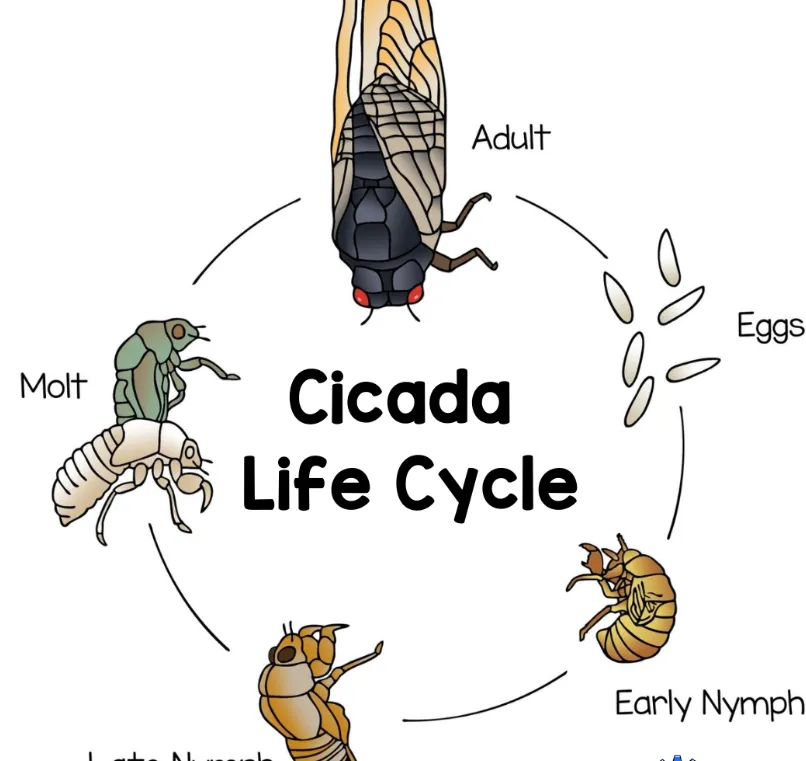
Cicadas belong to the insect order Hemiptera, which includes true bugs. Their scientific family is Cicadidae. They are not locusts, although people sometimes wrongly call them “locusts” because they appear in large numbers.
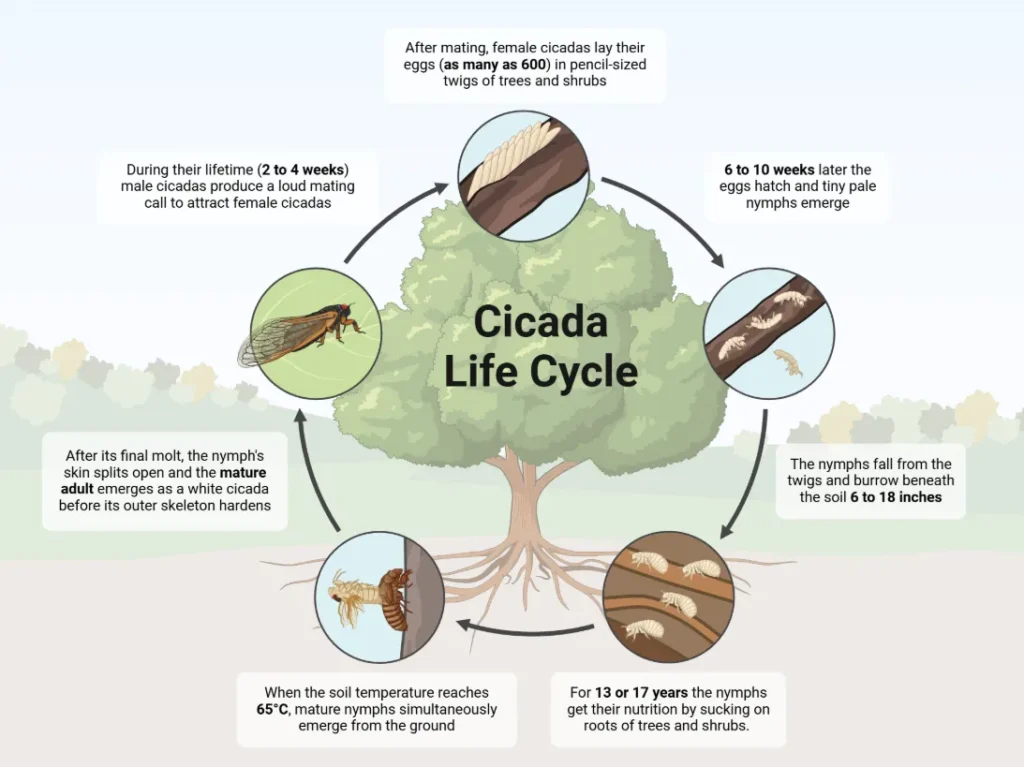
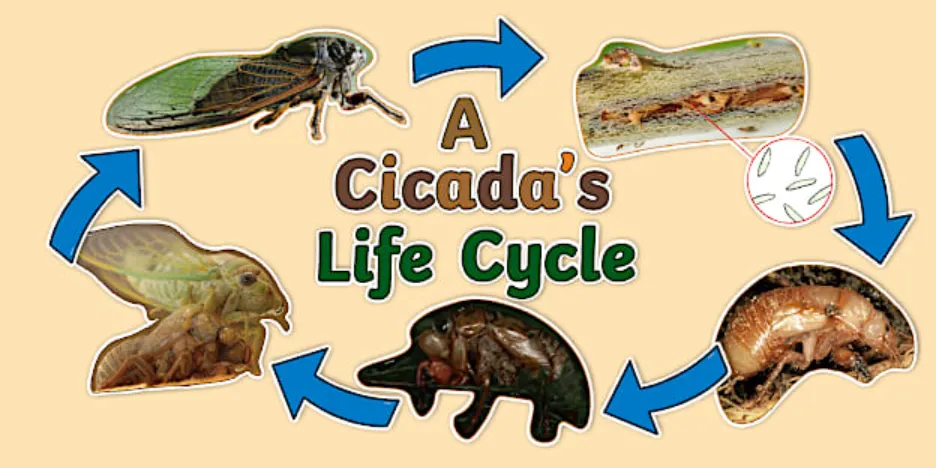
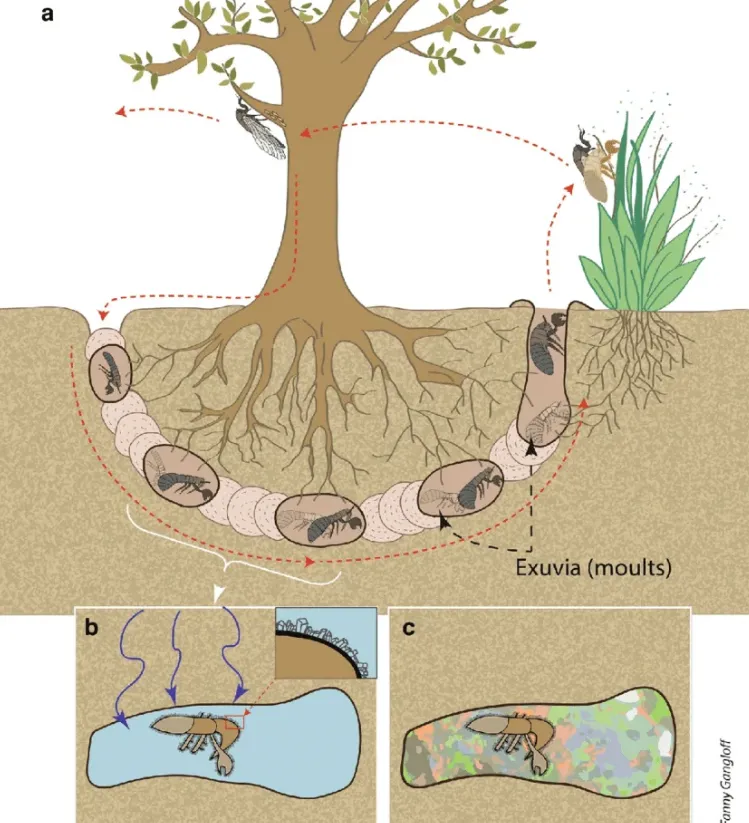
The basic life cycle includes eggs, underground nymphs, emerging nymphs, and adult cicadas. Female cicadas lay eggs inside small cuts in tree twigs. After hatching, young nymphs drop to the ground, burrow into the soil, and feed on liquid from plant roots.
Some common cicadas may develop underground for 2 to 5 years, while famous periodical cicadas can stay underground for 13 or 17 years. When they finally emerge, adults live only a few weeks. During that short adult life, males sing, females mate and lay eggs, and the cycle begins again.
Quick Answers: Most Common Questions
Q: How many stages are in the life cycle of a cicada?
A: A cicada has three main biological stages: egg, nymph, and adult. For easier understanding, the nymph stage is often divided into the underground nymph and the emerging nymph.
Q: How long does a cicada live?
A: It depends on the species. Many cicadas live 2 to 5 years, while periodical cicadas live 13 or 17 years, mostly underground.
Q: What do cicadas eat?
A: Cicadas feed mainly on xylem fluid, a watery sap from plant roots, stems, and tree tissues. They do not chew leaves like caterpillars.
Quick Life Cycle Table
| Stage | Where It Happens | What Happens | Approx. Time |
| Egg | Tree twigs or branches | Females lay eggs in small slits | 2–10 weeks |
| Young Nymph | Soil near roots | Nymph drops down and burrows underground | Starts after hatching |
| Underground Nymph | Beneath soil | Feeds on root sap and molts several times | 2–17 years |
| Emerging Nymph | Tree trunks, plants, walls | Climbs up and sheds old skin | Few hours |
| Adult Cicada | Trees and shrubs | Sings, mates, lays eggs, dies | 3–6 weeks |
Important Things That You Need To Know
When studying the life cycle of a cicada, it is important to understand that not every search term with “cicada” means the same thing. The main keyword cicada refers to the real insect that lives underground, sings loudly, and plays a valuable role in nature.
A cicada killer is not a cicada. It is a large solitary wasp that hunts cicadas, especially adult cicadas, to feed its young. The cicada killer wasp may look frightening, but it is usually not aggressive unless handled. It is part of the natural predator-prey balance.
The phrase covid 19 cicada variant is not connected to insects. It refers to a media nickname for a SARS-CoV-2 variant. Similarly, the cicada COVID variant BA.3.2 is a public health topic, not an animal biology topic. This article focuses on real cicadas, but it is useful to know the difference so readers do not confuse insect science with medical news.
Another unrelated term is cicada 3301. This refers to a mysterious internet puzzle and cryptography challenge, not a living insect. It became popular online because of its secretive digital clues.
So, when learning about cicadas, remember this clearly: the real cicada is an insect, the cicada killer wasp is a predator, the covid 19 cicada variant is a virus nickname, and cicada 3301 is an internet mystery. These terms share the same word but belong to very different topics.
The History Of Their Scientific Naming, Evolution, and Origin
Scientific Naming of Cicadas
The word cicada comes from Latin and has been used for centuries to describe these loud-singing insects. Scientifically, cicadas belong to the order Hemiptera, suborder Auchenorrhyncha, and family Cicadidae.
The best-known periodical cicadas belong to the genus Magicicada. This name is often linked with their almost “magical” synchronized emergence after 13 or 17 years underground.
Evolutionary Background
Cicadas are ancient insects with a long evolutionary history. Their ancestors appeared millions of years ago, and fossil evidence shows cicada-like insects existed during the age of dinosaurs.
Their strong underground nymph stage, piercing mouthparts, and sound-producing organs helped them survive across changing environments.
Origin and Global Distribution
Cicadas are found on many continents, especially in warm and temperate regions. They live in forests, grasslands, gardens, farms, and urban areas where trees and shrubs are available.
The famous periodical cicadas are mainly found in eastern North America, while many annual or non-periodical cicadas live across Asia, Africa, Europe, Australia, and the Americas.
Their Reproductive Process, Giving Birth, And Rising Their Children
Male Cicadas Attract Females by Singing
The reproductive process begins when adult male cicadas produce loud calls using special sound organs called tymbals. These sounds are not random noise. They are mating songs designed to attract females of the same species.
In large groups, male cicadas may form powerful choruses. This makes it easier for females to locate males and also helps overwhelm predators through sheer numbers.
Mating Happens Soon After Emergence
Adult cicadas do not have much time. After spending years underground, they emerge for only a short time as adults. Once their wings harden, males begin calling, and females respond.
After mating, the female prepares to lay eggs. She does not give birth to live young. Cicadas reproduce by laying eggs.
Females Lay Eggs in Tree Twigs
A female cicada uses her sharp ovipositor, or egg-laying organ, to make small slits in young tree branches or twigs. She places eggs inside these cuts, where they remain protected.
Depending on the species, one female may lay hundreds of eggs. These eggs usually hatch after several weeks.
Young Cicadas Raise Themselves
Cicadas do not raise their young like birds or mammals. Once the eggs hatch, tiny nymphs drop to the ground and dig into the soil.
From that moment, the young survive independently. They find roots, feed on sap, molt as they grow, and remain underground until they are ready to emerge as adults.
Stages Of Cicada Life Cycle
Stage 1: Egg Stage
The first stage in the life cycle of a cicada begins when the female lays eggs inside tree branches. She carefully cuts narrow slits into the woody tissue and places eggs inside.
This protects the eggs from many predators and weather conditions. After a few weeks, the eggs hatch into tiny nymphs.
Stage 2: Underground Nymph Stage
After hatching, the young nymphs fall or crawl down to the soil. They dig underground with their strong front legs and begin feeding on the fluid from plant roots.
This is the longest and most important stage. Nymphs grow slowly and molt several times. Many cicadas spend several years underground, while periodical cicadas remain hidden for 13 or 17 years.
Stage 3: Emergence and Molting Stage
When the nymph matures, it tunnels upward and emerges from the ground, usually in warm weather. It climbs a tree trunk, a fence, a wall, or a plant stem.
Then it splits open its outer shell and pulls out as a soft, pale adult. This empty shell is often seen attached to trees.
Stage 4: Adult Reproductive Stage
The adult cicada’s main job is reproduction. Males sing loudly, females choose mates, and eggs are laid in twigs.
Adult cicadas live only a few weeks. After mating and egg laying, they die naturally, and their bodies return nutrients to the soil.
Their Main Diet, Food Sources, And Collection Process Explained
What Cicada Nymphs Eat
Cicada nymphs feed mainly on xylem fluid from plant roots. Xylem is a watery fluid that carries water and minerals throughout plants.
Because xylem is low in nutrients, cicadas must feed for a long time. This helps explain why their nymph stage can last for years.
What Adult Cicadas Eat
Adult cicadas also use piercing-sucking mouthparts to take small amounts of fluid from trees and plants. They do not bite people, chew leaves, or destroy crops like locusts.
Their feeding is usually not harmful to mature trees. However, egg-laying cuts may damage very young or weak branches.
How Cicadas Collect Food
Cicadas do not collect food like ants or bees. Instead, they insert their straw-like mouthparts into plant tissue and suck liquid.
Nymphs feed underground from roots. Adults feed on aboveground parts of woody plants, such as stems and branches.
Preferred Food Sources
Cicadas commonly use trees and shrubs such as oak, maple, hickory, fruit trees, and other woody plants. They need healthy plant roots to complete their long underground development.
How Long Does A Cicada Live
The lifespan of a cicada depends strongly on its species. Some live only a few years, while periodical cicadas are famous for their extremely long life cycles.
- Most of a cicada’s life is underground.
- A cicada spends the majority of its life as a nymph beneath the soil. During this time, it feeds on root fluid, grows slowly, and molts several times.
- Common cicadas may live 2 to 5 years.
- Many cicadas seen every summer are called annual cicadas, but this does not always mean each lives only one year. It often means some members of the population emerge every year.
- Some cicadas may stay underground longer.
- In some regions, nymph development can take several years depending on species, root quality, soil temperature, and environmental conditions.
- Periodical cicadas live 13 or 17 years.
- The most famous cicadas are the Magicicada species. They emerge in huge synchronized groups after either 13 or 17 years underground.
- Adult cicadas live only a short time.
- After emergence, adult cicadas usually live around 3 to 6 weeks. Their adult stage is short because their main purpose is to mate and lay eggs.
- Males often die after mating activity.
- Male cicadas spend much of their adult energy calling loudly to attract females. This makes them visible and vulnerable to predators.
- Females die after laying eggs.
- Once females deposit their eggs in tree branches, their life cycle is complete.
- Weather affects adult survival.
- Heavy rain, extreme heat, predators, and habitat disturbance can shorten adult life.
- The full cicada lifespan is not the same as the adult lifespan.
- When people ask “How long does a cicada live?” they often mean the adult insect. But scientifically, the full life includes many years as an underground nymph.
Cicada Lifespan in the Wild vs. in Captivity
Lifespan in the Wild
In the wild, cicadas follow their natural rhythm. They hatch in trees, develop underground, emerge when conditions are right, mate, lay eggs, and die.
Wild cicadas have access to living roots, natural soil moisture, seasonal temperature changes, and proper emergence cues. This makes the wild the best place for their full life cycle.
Lifespan in Captivity
Cicadas are difficult to keep in captivity because their nymphs need living plant roots for years. Adults also need space, proper temperature, and natural surfaces for climbing and mating.
Adult cicadas kept in containers may survive only a few days or weeks if conditions are poor. Full captive rearing from egg to adult is very challenging and usually done only in research settings.
Which Life Is Better for Cicadas?
The wild is far better for cicadas. Their life cycle depends on soil, trees, roots, seasonal changes, and synchronized emergence. Captivity cannot easily recreate this complex natural system.
Importance of Cicada In This Ecosystem
Cicadas Feed Many Animals
Cicadas are an important food source for birds, fish, reptiles, mammals, spiders, and insects. During mass emergence, many animals eat them heavily.
This sudden food supply can support wildlife reproduction and survival.
They Return Nutrients to Soil
After adult cicadas die, their bodies decompose, enriching the soil. This returns nutrients, such as nitrogen, to the ecosystem.
Trees and plants may benefit from this natural nutrient recycling.
They Help Aerate Soil
When cicada nymphs dig tunnels underground, they loosen the soil. This can improve air movement and groundwater flow.
Their tunnels are small but can become ecologically meaningful when many cicadas emerge together.
They Support Predator-Prey Balance
Cicadas are prey for many animals, including the cicada killer wasp. Their presence supports a wider food web.
Even though they are noisy, cicadas are not pests in the same way as crop-destroying insects. They are part of a healthy, natural cycle.
What To Do To Protect Them In Nature And Save The System For The Future
Protect Mature Trees
- Cicadas depend on trees for egg-laying and root feeding.
- Avoid unnecessary cutting of mature trees, especially in areas known for periodical cicadas.
- Healthy trees help future cicada generations survive underground.
Avoid Heavy Pesticide Use
- Do not spray pesticides just because cicadas are noisy.
- Cicadas do not sting, bite, or spread disease to humans.
- Pesticides can harm cicadas, pollinators, birds, and soil organisms.
Cover Young Trees During Emergence
- Female cicadas may damage very young trees while laying eggs.
- Use fine-mesh netting to protect saplings.
- Avoid planting new small trees right before a large periodical emergence.
Let Natural Predators Do Their Job
- Birds, mammals, spiders, and cicada killer wasps naturally control cicada populations.
- Do not destroy harmless predator species unless they pose a direct danger.
Report Cicada Sightings
- Citizen science reports help researchers map cicada broods.
- Photos and location records can improve knowledge about emergence patterns.
- This is especially useful for off-cycle or unusual cicada appearances.
Fun & Interesting Facts About Cicada
- Cicadas are among the loudest insects in the world.
- Male cicadas can produce powerful sounds to attract females.
- They spend most of their lives underground.
- A periodical cicada may live over a decade as a hidden nymph before appearing aboveground.
- Their empty shells are not dead cicadas.
- The brown shell left on trees is the old exoskeleton after molting.
- Cicadas are not locusts.
- Locusts are grasshoppers, while cicadas are true bugs.
- Periodical cicadas use survival by numbers.
- When millions emerge together, predators cannot eat them all.
- Some cicadas appear every summer.
- These are often called annual cicadas, even though individuals may take several years to develop.
- Cicadas do not bite or sting humans.
- They may land on people by mistake, but they are harmless.
- Cicada songs are species-specific.
- Different species produce different sounds to find the right mate.
- Cicadas help recycle nutrients.
- After death, their bodies enrich the soil.
- Cicada 3301 is not an insect.
- It is an internet puzzle mystery that only shares the name “cicada.”
Frequently Asked Questions (FAQs)
Q: What is the life cycle of a cicada?
A: The life cycle of a cicada includes egg, nymph, emergence, and adult reproduction. Eggs hatch in tree branches, nymphs burrow underground, mature nymphs emerge, and adults mate and lay eggs.
Q: How long do cicadas stay underground?
A: Many cicadas stay underground for several years. Some common cicadas develop in about 2 to 5 years, while periodical cicadas stay underground for 13 or 17 years.
Q: Are cicadas harmful to humans?
A: No. Cicadas do not bite, sting, or attack people. They are noisy but harmless. The main risk is minor twig damage when females lay eggs in young trees.
Q: What is a cicada killer wasp?
A: A cicada killer wasp is a large, solitary wasp that hunts cicadas. It is a natural predator and is usually not aggressive toward humans unless handled.
Q: Is the covid 19 cicada variant related to cicadas?
A: No. The COVID-19 cicada variant, or th cicada COVIDCOVID-19t BA. 2.2BA. 3.2 is an informal media nickname for a SARS-CoV-2 variant. It has no biological connection to cicada insects.
Final Word
The life cycle of a cicada is a powerful example of patience, timing, survival, and natural balance. From tiny eggs hidden in tree twigs to years of underground growth and a short but noisy adult life, cicadas follow one of the most unusual life patterns in the insect world.
They may seem loud or strange, but cicadas are valuable members of the ecosystem. They feed wildlife, improve soil, recycle nutrients, and show how deeply connected insects are with trees, weather, and seasonal rhythms.
Understanding cicadas also helps us avoid confusion with unrelated terms such as cicada killer, the cicada COVID variant BA.3.2, and cicada 3301. The real cicada is not a danger. It is a remarkable insect with a life story that can last for years beneath our feet before finally rising into the sunlight.
Also Read: life cycle moss