Admin
Admin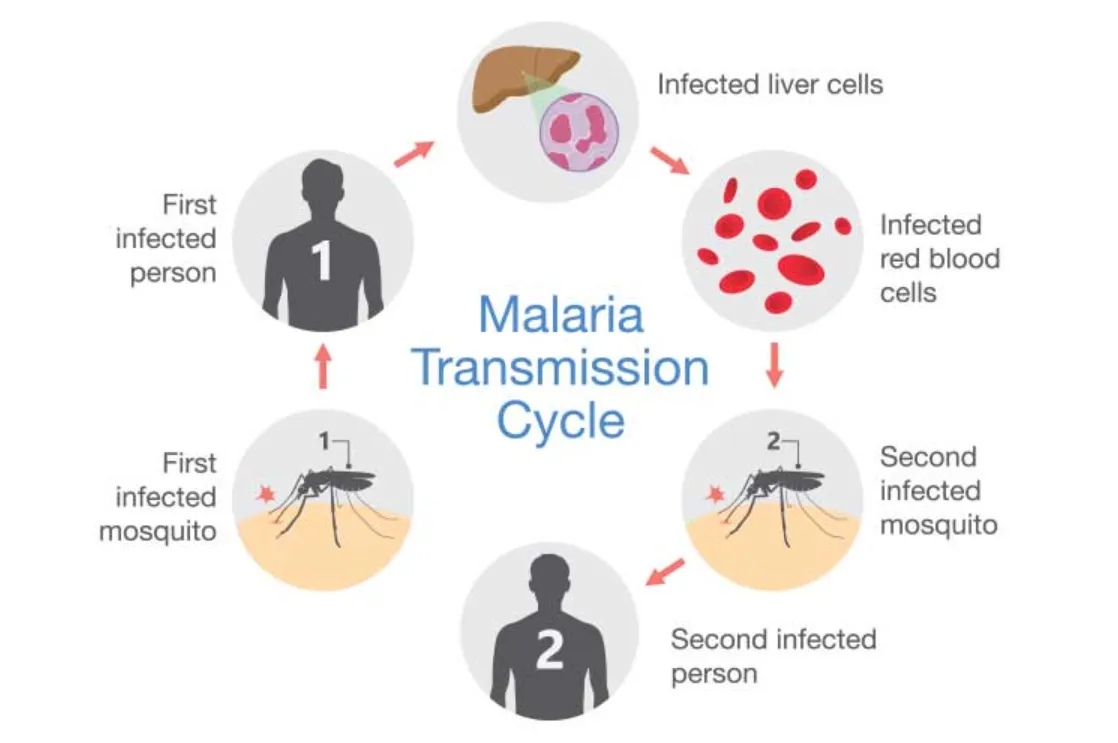
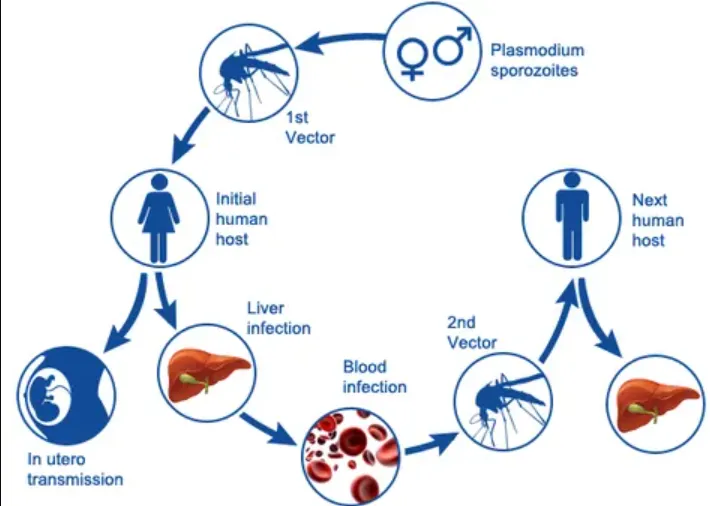
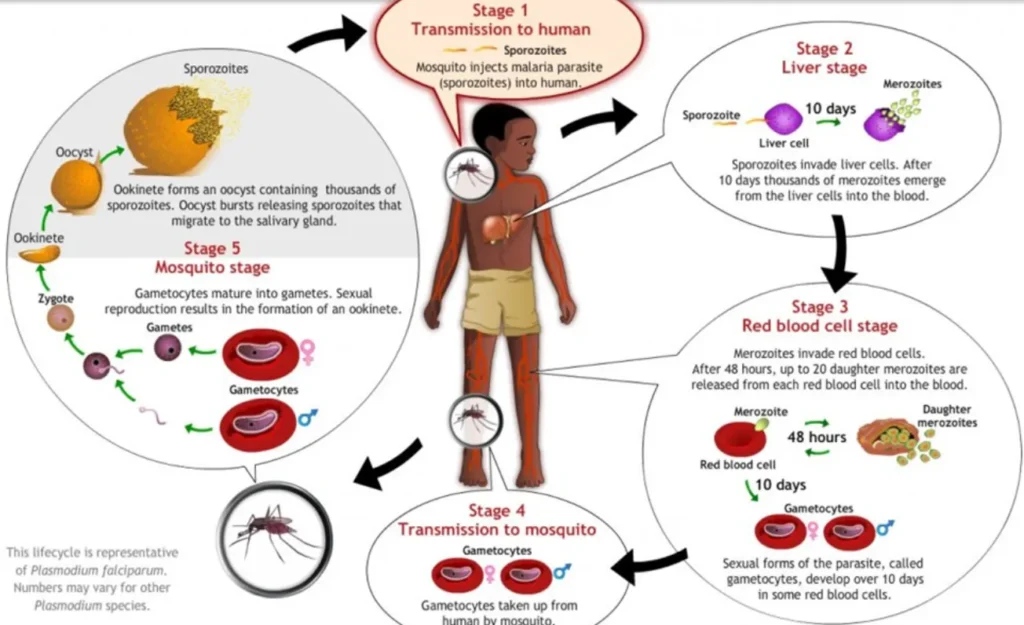
The life cycle of the malarial parasite Plasmodium is among the most complex in biology because it requires two hosts: a human host and a female Anopheles mosquito. Plasmodium is not a worm or insect; it is a single-celled protozoan parasite that causes malaria, a serious disease marked by fever, chills, sweating, fatigue, anemia, and sometimes severe complications.
The most important human-infecting species are Plasmodium falciparum, Plasmodium vivax, Plasmodium malariae, Plasmodium ovale, and the zoonotic species Plasmodium knowlesi. Among them, P. falciparum is the most dangerous and causes the most severe malaria deaths, while P. vivax and P. ovale can form dormant liver stages called hypnozoites, which may reactivate later. CDC describes the malaria parasite life cycle as a two-host cycle involving mosquito transmission, liver infection, blood-stage multiplication, and sexual development inside the mosquito.
According to the latest WHO malaria fact sheet, there were about 282 million malaria cases and 610,000 malaria deaths globally in 2024, showing why understanding the malarial parasite Plasmodium remains important for health education and disease prevention.
Quick Answers: Most Common Questions
Q: What is the life cycle of the malaria parasite Plasmodium?
A: It is a two-host cycle. Plasmodium develops first in humans through the liver and red blood cell stages, then continues its sexual cycle inside a female Anopheles mosquito.
Q: Which stage of Plasmodium infects humans?
A: The sporozoite stage infects humans when an infected female Anopheles mosquito bites and injects parasites into the bloodstream.
Q: Which stage of Plasmodium infects mosquitoes?
A: The gametocyte stage infects mosquitoes when they feed on blood from an infected human.
Quick Life Cycle Table
| Stage | Main Host | Main Location | What Happens |
| Sporozoite | Human | Bloodstream to liver | Mosquitoes inject infective parasites |
| Liver Schizont | Human | Liver cells | Parasites multiply silently |
| Merozoite | Human | Red blood cells | Parasites invade and destroy RBCs |
| Gametocyte | Human/Mosquito | Human blood | Sexual forms develop |
| Gamete & Zygote | Mosquito | Mosquito gut | Male and female forms fuse |
| Ookinete | Mosquito | Gut wall | The motile stage penetrates the gut wall |
| Oocyst | Mosquito | Outer gut wall | Thousands of sporozoites form |
| New Sporozoite | Mosquito | Salivary glands | Ready to infect another human |
Important Things That You Need To Know
The malarial parasite Plasmodium is medically important because it connects human biology, mosquito ecology, climate, public health, and disease control. The parasite cannot complete its full life cycle in humans alone. It needs the female Anopheles mosquito for sexual reproduction and transmission.
The life cycle of the malarial parasite Plasmodium primarily refers to the full journey from the sporozoite stage to the liver stage, then to the blood stage, then to the gametocyte stage, and finally to the mosquito stage. This makes malaria different from many infections because stopping even one stage can reduce transmission.
The LSI keyword malaria parasite Plasmodium includes several species. Plasmodium falciparum is strongly associated with severe malaria. Plasmodium vivax is known for relapse because of dormant liver forms. Plasmodium malariae may persist for long periods. Plasmodium ovale can also relapse. Plasmodium knowlesi is linked with monkeys and can infect humans in parts of Southeast Asia. CDC’s Yellow Book lists these major human malaria parasites and notes the zoonotic importance of P. knowlesi.
For SEO and learning purposes, the most important terms to understand are the malarial parasite Plasmodium, the Plasmodium life cycle, the Anopheles mosquito, the sporozoite, and the merozoite. These terms explain how malaria spreads, why symptoms repeat, and why mosquito control is central to prevention.
The History of Their Scientific Naming, Evolution, and Origin
Discovery of the Malaria Parasite
The history of Plasmodium began scientifically in 1880, when the French physician Alphonse Laveran observed parasites in the blood of patients with malaria. This discovery changed malaria science because it proved malaria was caused by a living parasite, not by “bad air” or swamp gases, which were common old beliefs. Cox’s historical review explains that the modern understanding of malaria parasites began with Laveran’s discovery of malaria parasites in the blood.
Scientific Naming of Plasmodium
The genus name Plasmodium was later introduced by scientists studying the parasite’s form and development. The name is linked to the parasite’s changing shape during its life cycle. Different species were then identified, including P. falciparum, P. vivax, P. malariae, P. ovale, and P. knowlesi.
Evolution and Origin
Evolutionarily, Plasmodium belongs to the phylum Apicomplexa, a group of single-celled parasites with specialized structures for invading host cells. Modern evolutionary research suggests that malaria parasites evolved from ancient protozoan ancestors and became highly adapted to moving between vertebrate hosts and blood-feeding insects. Recent reviews also discuss the role of the parasite’s apicoplast, a remnant organelle linked to ancient photosynthetic ancestry, in parasite survival and adaptation.
Their Reproductive Process, Giving Birth, And Rising Their Children
Plasmodium Does Not Give Birth Like Animals
The phrase “giving birth” does not literally apply to Plasmodium. It is a single-celled parasite, so it does not produce babies, care for offspring, or raise young. Instead, it multiplies through biological reproduction stages inside human and mosquito hosts.
Asexual Reproduction in Humans
Inside humans, Plasmodium mainly reproduces asexually. After the sporozoite enters the human bloodstream, it travels to the liver. There, it invades liver cells and multiplies into many new parasites called merozoites.
After leaving the liver, merozoites invade red blood cells. Inside each red blood cell, the parasite grows, divides, and bursts the cell open. This releases more merozoites, which infect more red blood cells. This recurring cycle is responsible for many malaria symptoms, including fever waves, chills, anemia, and weakness.
Sexual Reproduction in Mosquitoes
Some blood-stage parasites do not continue asexual multiplication. Instead, they become male and female gametocytes. When a female Anopheles mosquito bites an infected person, it ingests these gametocytes with its blood meal.
Inside the mosquito gut, gametocytes mature into gametes. Male and female gametes fuse to form a zygote, which develops into an ookinete, then an oocyst. The oocyst produces many new sporozoites, which migrate to the mosquito’s salivary glands. Then the mosquito becomes ready to infect another human during its next bite.
Stages of Malarial Parasite Plasmodium Life Cycle
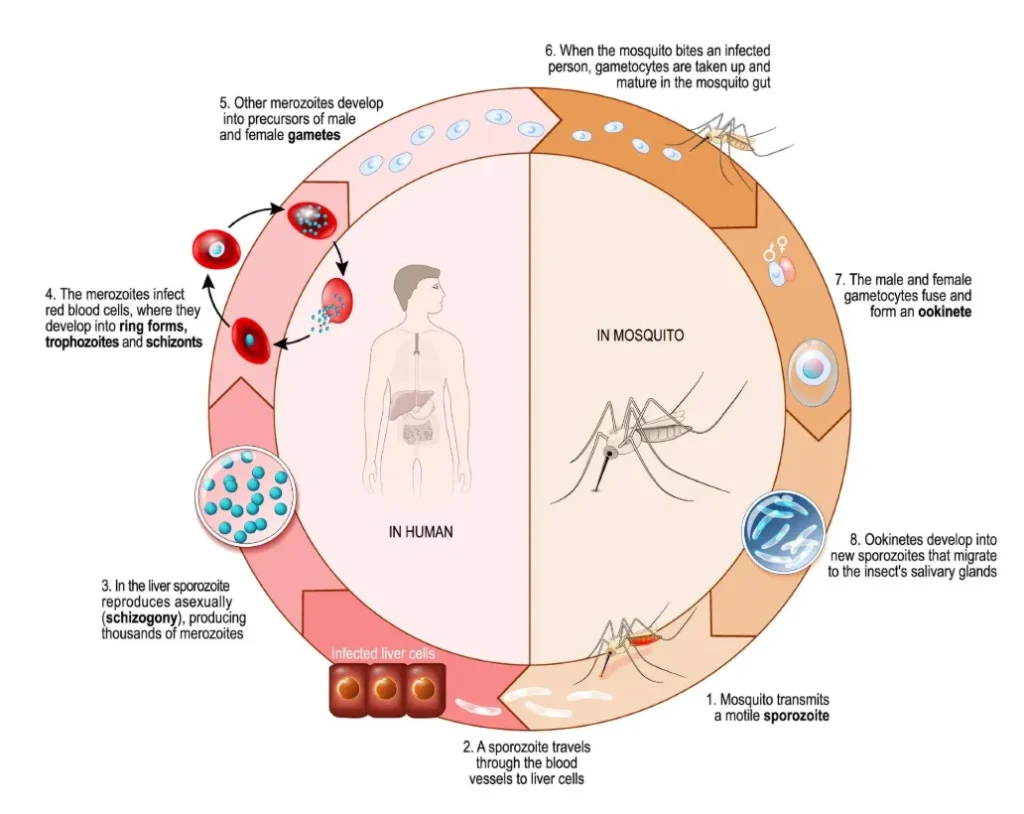
1. Sporozoite Stage: The Human-Infective Stage
The life cycle begins when an infected female Anopheles mosquito bites a human. The mosquito injects sporozoites into the bloodstream through saliva. These sporozoites do not remain in the blood for long. They quickly travel to the liver and invade liver cells.
This stage is important because the person may not feel sick immediately. The parasite is hidden in the liver, multiplying silently before symptoms appear.
2. Liver Stage: Silent Multiplication
Inside liver cells, sporozoites develop into schizonts. A schizont is a parasite-filled structure that produces many merozoites. When liver cells rupture, merozoites enter the bloodstream.
In P. vivax and P. ovale, some parasites can remain dormant as hypnozoites. These dormant forms may reactivate weeks, months, or even years later, causing relapse. CDC notes this dormant liver-stage feature for P. vivax and P. ovale.
3. Blood Stage: Red Blood Cell Infection
The merozoites invade red blood cells. Inside these cells, the parasite develops through ring, trophozoite, and schizont stages. When the infected red blood cell bursts, new merozoites are released.
This blood-stage cycle causes the classic symptoms of malaria. It also allows diagnosis, because parasites can often be seen in blood smears or detected by rapid tests.
4. Mosquito Stage: Sexual Cycle and Transmission
Some parasites develop into gametocytes rather than continuing the blood-stage cycle. When a mosquito feeds on infected blood, gametocytes enter the mosquito gut.
There, sexual reproduction occurs. Gametes fuse to form a zygote, which then forms an ookinete, which then forms an oocyst. The oocyst releases sporozoites, which then move to the mosquito’s salivary glands. The mosquito is then ready to transmit Plasmodium to another human.
Their main diet, food sources, and collection process are explained
Plasmodium Does Not Eat Like an Animal
The malarial parasite Plasmodium does not eat plants, insects, or solid food. It survives by absorbing and digesting nutrients from host cells. Its “food source” changes depending on its life stage.
Nutrients from Human Liver Cells
During the liver stage, Plasmodium uses nutrients from human liver cells to grow and multiply. This stage is highly efficient because one sporozoite can produce many merozoites.
Hemoglobin from Red Blood Cells
During the blood stage, the parasite’s main nutrient source is hemoglobin, the oxygen-carrying protein inside red blood cells. Research shows that P. falciparum digests a major portion of hemoglobin during its red blood cell stage, using the amino acids for growth.
Detoxifying Heme into Hemozoin
When Plasmodium digests hemoglobin, it releases toxic heme. To survive, the parasite converts this toxic material into a safer crystal-like waste product called hemozoin. This process is one reason the parasite can live inside red blood cells.
Nutrients Inside the Mosquito
Inside the mosquito, the parasite uses nutrients from the mosquito’s gut environment and undergoes sexual stages. The mosquito does not intentionally “feed” the parasite; the parasite exploits the blood meal and mosquito tissues to continue its life cycle.
How Long Does A Malarial Parasite, Plasmodium, Live
The lifespan of Plasmodium depends on the species, host, immune response, treatment, and life-cycle stage. It is better to understand its life as a cycle rather than a single fixed age.
- In the mosquito salivary gland:
- Sporozoites can remain infective in the mosquito and wait for the next blood meal. The exact survival time depends on the mosquito species, temperature, humidity, and the mosquito’s lifespan.
- In human blood before liver invasion:
- Sporozoites usually move quickly from the bloodstream to the liver. This phase is short and is not the main symptomatic period.
- In the liver stage:
- Liver-stage development may last days before merozoites enter the bloodstream. In P. vivax and P. ovale, dormant hypnozoites may persist for weeks, months, or years before relapse.
- In red blood cells:
- The blood-stage cycle repeats regularly. P. falciparum, P. vivax, and P. ovale often follow roughly 48-hour cycles, while P. Malariae is associated with a longer 72-hour cycle. P. knowlesi can multiply more rapidly, often within 24 hours.
- In an untreated infection:
- Some infections may last weeks, months, or longer. P. malariae is especially known for long persistence. P. vivax and P. ovale may return because of liver hypnozoites.
- With effective treatment:
- Blood-stage parasites can be cleared much faster. However, species with dormant liver stages need specific anti-relapse therapy under medical supervision.
- Inside laboratory culture:
- Some species, especially P. falciparum, can be maintained in controlled laboratory red blood cell culture systems for research. This is not a natural lifespan; it is a managed scientific environment.
- Main takeaway:
- There is no single lifespan for the malarial parasite Plasmodium. Its survival depends on whether it is in the mosquito, the liver, the blood, or a laboratory culture.
Malarial Parasite Plasmodium Lifespan in the Wild vs. in Captivity
Lifespan in the Wild
In the wild, Plasmodium survives through continuous movement between humans and mosquitoes. Its natural life depends on successful transmission. If a mosquito dies before the parasite reaches the salivary glands, the cycle stops. If an infected human is treated early, the blood-stage cycle may also stop.
Wild survival is influenced by climate, mosquito density, human immunity, bed-net use, drug treatment, insecticide resistance, and availability of breeding sites.
Lifespan in Captivity
“Captivity” for Plasmodium usually means laboratory conditions. Scientists can grow some malaria parasites, especially P. falciparum, in red blood cell cultures. Mosquito colonies may also be used in controlled research to study transmission.
In captivity, the parasite can be maintained longer because temperature, nutrients, host cells, and mosquito exposure are controlled. However, this is artificial and used for vaccine, drug, diagnostic, and biological research.
Main Difference
In nature, Plasmodium must survive unpredictable host immunity, the mosquito’s lifespan, environmental factors, and medical treatment. In the laboratory, it survives because scientists provide carefully controlled conditions.
Importance of Malarial Parasite Plasmodium in this Ecosystem
A Disease Organism, Not a Species to Protect
Plasmodium is not beneficial to humans. It causes malaria and contributes to illness, death, school absence, reduced productivity, and economic burden. Therefore, public health aims to control and eliminate malaria, not protect the parasite.
Ecological and Evolutionary Influence
Even harmful parasites can influence ecosystems. Plasmodium affects host populations, mosquito-human interactions, and evolutionary pressure. For example, malaria has strongly influenced human genetics in endemic regions, including traits related to red blood cells.
Part of Mosquito–Host Disease Ecology
The parasite depends on Anopheles mosquitoes and vertebrate hosts. Changes in rainfall, temperature, wetlands, land use, irrigation, and urbanization can affect mosquito breeding and the risk of malaria transmission.
Scientific Importance
Studying Plasmodium helps scientists understand cell invasion, immune evasion, parasite evolution, drug resistance, vaccine development, and vector-borne disease control. Its importance is therefore mainly scientific and public-health related, not conservation related.
What to do to protect them in nature and save the system for the future
For Plasmodium, the responsible goal is not to protect the parasite. The goal is to protect humans, biodiversity, and ecosystems by safely reducing malaria transmission.
1. Reduce Mosquito Breeding Sites
- Remove stagnant water around homes.
- Improve drainage in high-risk areas.
- Cover water containers.
- Manage irrigation and construction water responsibly.
2. Use Mosquito Protection
- Use insecticide-treated bed nets where malaria risk is present.
- Install window screens.
- Wear long sleeves in mosquito-active times.
- Use approved repellents according to local guidance.
3. Support Early Diagnosis and Treatment
- Fever in malaria-endemic areas should be tested quickly.
- Proper treatment reduces severe disease.
- Treating infections also reduces the risk that mosquitoes will pick up gametocytes.
4. Protect Ecosystems Without Increasing Disease Risk
- Avoid careless wetland destruction, but manage human-made stagnant water.
- Use targeted vector control instead of unnecessary chemical overuse.
- Support environmentally responsible mosquito-control programs.
5. Strengthen Public Health Systems
- Improve surveillance.
- Monitor drug and insecticide resistance.
- Support vaccines, diagnostics, and community education.
- Focus on high-risk groups such as children and pregnant women.
Fun & Interesting Facts About Malarial Parasite Plasmodium
- Plasmodium has one of the most complicated life cycles among human parasites.
- It needs both a human and a female Anopheles mosquito to complete its full life cycle.
- The parasite changes shape many times: sporozoite, merozoite, trophozoite, schizont, gametocyte, ookinete, and oocyst.
- P. vivax and P. ovale can hide in the liver as dormant hypnozoites.
- The blood-stage parasite digests hemoglobin and produces dark malaria pigment called hemozoin.
- Only female Anopheles mosquitoes transmit human malaria because they take blood meals for egg development.
- P. knowlesi is called a zoonotic malaria parasite because it naturally infects monkeys but can also infect humans.
- Malaria symptoms often appear in cycles because infected red blood cells rupture in repeated waves.
- Plasmodium falciparum is especially dangerous because infected red blood cells can stick to blood vessel walls.
- The parasite is tiny, but its global impact is enormous.
Frequently Asked Questions (FAQs)
Q: What is the life cycle of the malaria parasite Plasmodium?
A: The life cycle includes the human liver stage, the human blood stage, and the mosquito sexual stage. It begins when an infected female Anopheles mosquito injects sporozoites into a human and continues when another mosquito takes gametocytes from infected blood.
Q: What are the four main stages of the Plasmodium life cycle?
A: The four main learning stages are the sporozoite stage, the liver stage, the blood stage, and the mosquito sexual stage.
Q: Which Plasmodium species causes the most severe malaria?
A: Plasmodium falciparum is generally the most dangerous human malaria parasite and is responsible for most severe malaria cases and deaths.
Q: Why does malaria fever come again and again?
A: Fever often repeats because infected red blood cells rupture in cycles, releasing new parasites and triggering immune reactions.
Q: Can Plasmodium live outside the human or mosquito body?
A: Naturally, Plasmodium depends on living host cells. It does not survive like free-living insects or worms in soil or water. Some species can be maintained in laboratories under controlled conditions.
Conclusion
The life cycle of the malaria parasite Plasmodium is a remarkable yet harmful biological process that involves two hosts, multiple body locations, and several specialized parasite forms. From sporozoites entering the human liver to merozoites destroying red blood cells and gametocytes continuing the cycle in mosquitoes, every stage plays a role in malaria transmission.
Understanding the Plasmodium life cycle helps explain why malaria prevention requires more than one strategy. Bed nets, mosquito control, early diagnosis, effective treatment, vaccines, and surveillance all target different parts of the cycle. The parasite is scientifically fascinating, but it remains a major public-health threat. A clear understanding of the malarial parasite Plasmodium can support better awareness, stronger prevention, and smarter disease-control efforts worldwide.
Also Read: cheetah life cycle