Admin
Admin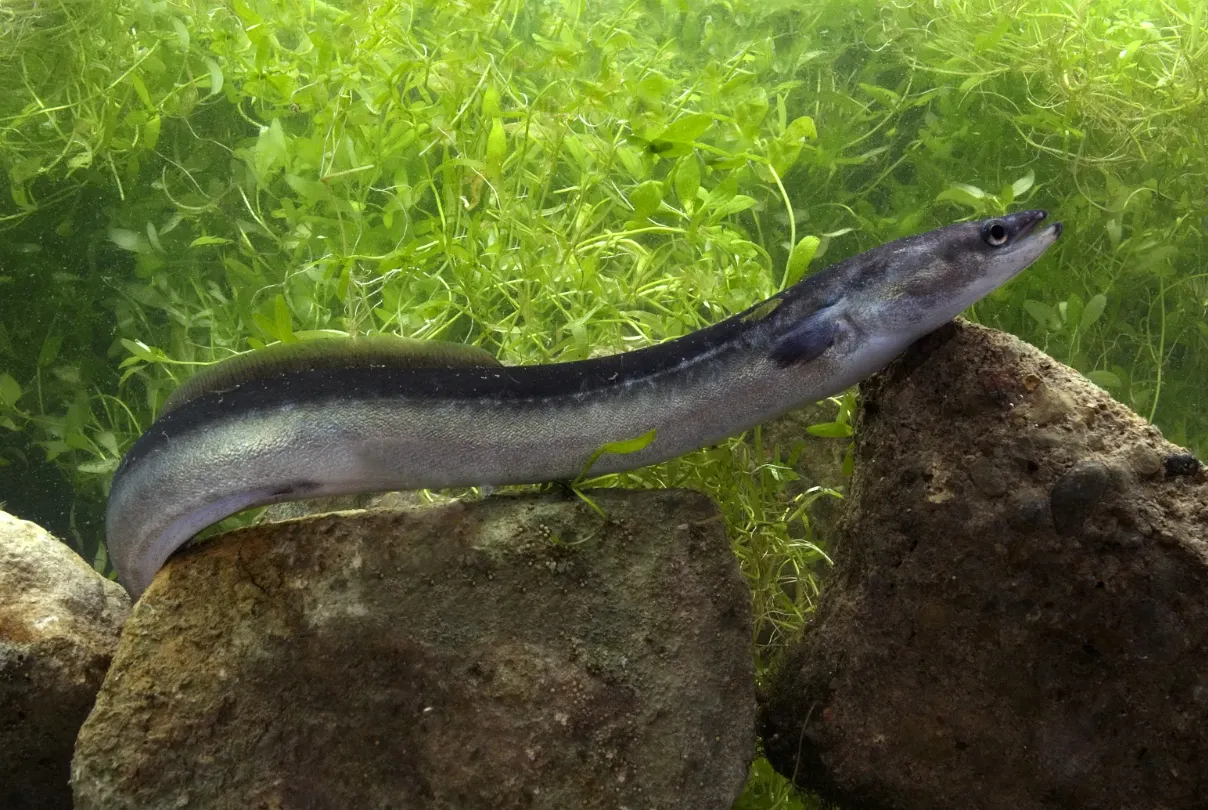
The eel life cycle is one of the most mysterious and fascinating life cycles in the fish world. Unlike many freshwater fish, many true freshwater eels, especially Anguilla species such as the American eel, European eel, and Japanese eel, are catadromous. This means they spend much of their growing life in freshwater, rivers, wetlands, lakes, or estuaries, but return to the ocean to reproduce. Britannica explains that catadromous fish live mostly in freshwater and migrate to the sea to breed, with eels of the genus Anguilla as classic examples.
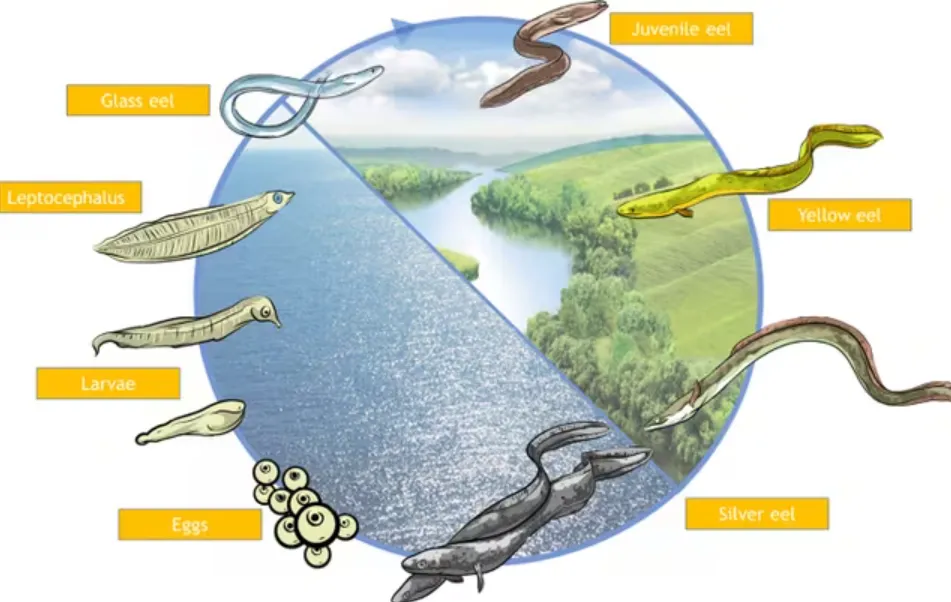
A typical eel begins life as an egg in the ocean. After hatching, it becomes a thin, transparent, leaf-shaped larva called a leptocephalus. This larval stage drifts with ocean currents before transforming into a glass eel, then an elver, then a yellow eel, and finally a mature silver eel that migrates back to the ocean to spawn. The American eel life cycle includes larvae, glass eel, juvenile yellow eel, and mature silver eel stages, with some stages migrating thousands of miles between marine and continental waters.
Eels are important predators, scavengers, and nutrient movers in aquatic ecosystems. Their life connects oceans, rivers, wetlands, and coastal habitats. This makes the eel life cycle not only a biological wonder but also an important part of ecosystem balance.
Q: What are the main stages of the eel life cycle?
A: The main stages are egg, leptocephalus larva, glass eel, elver, yellow eel, and silver eel.
Q: Where do many freshwater eels reproduce?
A: Many freshwater eels reproduce in the ocean. For example, American and European eels are strongly linked with the Sargasso Sea as a spawning region.
Q: Do eels give birth to live young?
A: No. True eels do not give live birth. They reproduce by releasing eggs and sperm in the ocean.
Quick Life Cycle Table
| Life Stage | Simple Description | Main Habitat | Key Change |
| Egg | Tiny eggs are released into the ocean water | Open ocean | Beginning of life |
| Leptocephalus | Transparent, leaf-like larva | Ocean currents | Drifts and feeds |
| Glass Eel | Small, clear young eel | Coast and estuary | Moves toward land |
| Elver | Pigmented juvenile eel | Rivers and streams | Starts active growth |
| Yellow Eel | Growing adult-like eel | Freshwater, brackish water, wetlands | Feeds and gains fat |
| Silver Eel | Mature migrating eel | River to ocean | Returns to spawn |
Important Things That You Need To Know
The word eel is used in many ways, but not every animal with “eel” in its name is a true eel. A true eel belongs to the order Anguilliformes, while some eel-like animals belong to other fish groups. For example, the electric eel is not a true eel; Britannica describes it as a South American fish related to characin fishes rather than true eels.
A moray eel is a true eel and belongs to the family Muraenidae. Moray eels are usually marine predators that live around reefs, rocks, and crevices in tropical and subtropical seas. A gulper eel is also eel-like and is related to deep-sea forms, but it belongs to a different group, often discussed separately from freshwater Anguilla eels.
The wolf eel is another confusing name. It looks long and eel-like, but it is not a true eel. It is a marine fish from the North Pacific. This shows why common names can be misleading.
Food-related searches such as “eel sauce” and “sushi nigiri eel near me” usually refer to cooked eel dishes, especially Japanese-style unagi or anago. However, people should understand that many eel populations face pressure from overfishing, habitat loss, dams, pollution, and illegal trade. Game searches like “eel” Stardew Valley are different because they refer to a virtual eel in a video game, not to real eel biology.
The History of Their ‘Scientific Naming’, ‘Evolution and Their Origin.’
Scientific Naming of Eels
True eels are classified under the order Anguilliformes. Freshwater eels belong mainly to the family Anguillidae and the genus Anguilla. Examples include Anguilla rostrata for the American eel, Anguilla anguilla for the European eel, and Anguilla japonica for the Japanese eel.
The scientific name helps avoid confusion because many animals have “eel” in their common name, but are not true eels. For example, electric eel and wolf eel are eel-like in shape but are not classified as true eels.
Evolution and Origin
Eels are ancient fish with a highly specialized body shape. Their long, flexible bodies help them move through narrow spaces, soft mud, rocky reefs, riverbanks, and deep-water habitats.
Freshwater eels of the genus Anguilla are especially interesting because they connect oceanic and inland ecosystems. One NOAA-linked stock assessment notes the genus Anguilla’s long evolutionary history. It describes American eels as having a multi-habitat, multi-phase life cycle that spans the open ocean, estuaries, and continental waters.
Why Their Origin Was Mysterious
For centuries, people did not understand where eels came from because adult eels were found in rivers, but their eggs and young larvae were not readily available. Their transformation from transparent larvae to adult-like eels made early scientists think the stages might belong to different animals.
Their Reproductive Process, Giving Birth, And Rising Their Children
Eels Do Not Give Live Birth
Eels do not give birth like mammals. They reproduce by spawning, in which females release eggs and males release sperm into the ocean. Fertilized eggs hatch into larvae.
This is why the phrase “giving birth” is not scientifically correct for eels. A better term is egg-laying reproduction or spawning reproduction.
Ocean Spawning
Freshwater eels such as American and European eels spend years growing in rivers, estuaries, wetlands, or lakes. When mature, they become silver eels and migrate back toward the ocean.
During this stage, their bodies change for long-distance travel. Their eyes become larger, their skin becomes more silvery, and they store energy as fat. After reaching the spawning area, they reproduce, and most evidence suggests they die after spawning.
No Parental Care
Eels do not build nests, guard eggs, or raise their young. Once eggs are released and fertilized, the next generation develops independently.
The larvae float in the ocean and depend on currents, food availability, and survival conditions. This makes the early life cycle of eels highly dependent on healthy ocean systems.
Why Reproduction Is Hard to Study
Eel reproduction is difficult to observe because it occurs far offshore, often in deep or open-ocean areas. Scientists know much about migration and life stages, but some exact spawning behaviors remain difficult to study directly.
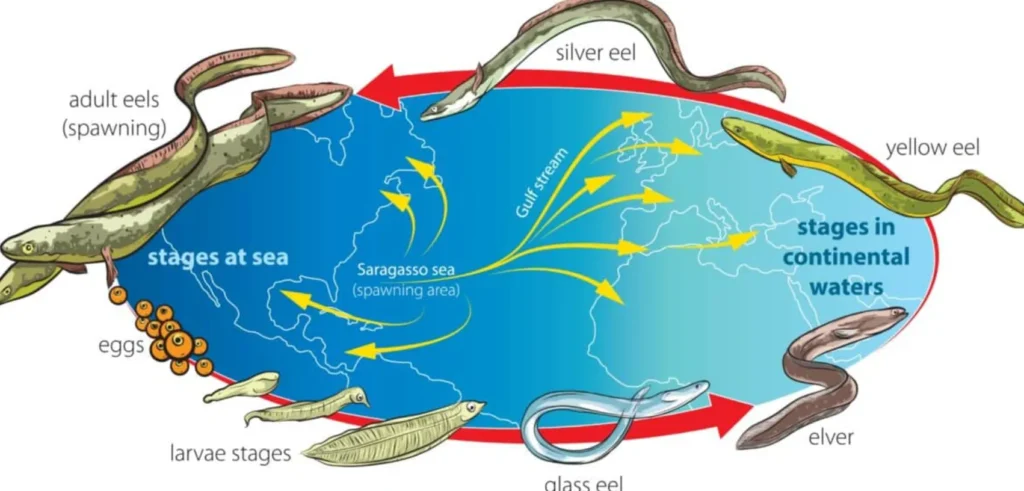
Stages of the Eel Life Cycle
Egg and Ocean Beginning
The eel life cycle starts with eggs in the ocean. These eggs are small, delicate, and part of the open-water planktonic environment. After fertilization, they hatch into larvae.
This first stage is hard to observe in nature because spawning happens far from rivers and human settlements. In many freshwater eel species, the ocean is the birthplace, even though the adult eel may spend years in freshwater.
Leptocephalus Larva
The second stage is the leptocephalus stage. This is one of the most unique features of eel biology. The larva is transparent, flat, and leaf-like. Britannica notes that eels pass through a leptocephalus stage in the open ocean before transforming into juveniles.
These larvae drift with ocean currents. They do not look like adult eels, which is why their identity has confused scientists in the past.
Glass Eel and Elver
As the larva approaches coastal areas, it changes into a glass eel. This stage is called “glass” because the young eel is still mostly transparent.
After entering estuaries or rivers, the glass eel becomes darker and is called an elver. The American eel report explains that glass eels become pigmented after entering estuaries and rivers, and are often called elvers or small yellow eels.
Yellow Eel and Silver Eel
The yellow eel stage is the main stage for feeding and growth. Eels may spend many years in this form, feeding at night and hiding during the day.
When mature, the eel becomes a silver eel. This final stage is built for migration. Silver eels leave freshwater or coastal habitats and travel back to the ocean to reproduce.
Their main diet, food sources, and collection process are explained
Eels eat different foods at different life stages. Their diet changes as their bodies, habitats, and hunting abilities change.
At the larval stage, eel feeding was once a mystery. Research from the University of Tokyo reports that natural eel larvae, called leptocephali, feed on particulate organic matter, often described as marine snow, which forms from decomposed plankton and other tiny oceanic particles.
As glass eels and elvers, they begin to feed on small aquatic animals. These may include tiny crustaceans, insect larvae, and organic matter in estuaries and rivers.
Adult yellow eels are usually nocturnal feeders. They often hunt or scavenge at night. Their food sources include:
- Aquatic insects
- Worms
- Small fish
- Crustaceans
- Mollusks
- Dead animal matter
- Small amphibians, where available
Animal Diversity Web describes European eels as having a broad diet in adulthood, including fish, insects, mollusks, worms, crustaceans, carrion, zooplankton, and detritus.
Their food collection process is based on smell, touch, night activity, and bottom searching. Eels often search muddy bottoms, river edges, stones, roots, and hidden places. They are not fast open-water hunters like tuna; instead, they are secretive, flexible, and patient feeders.
How Long Does A Eel Live
The lifespan of an eel depends on species, habitat, temperature, food availability, migration success, predators, and human pressure. Eels are generally long-lived compared with many small fish.
- Freshwater eels can live for many years. Some may spend only a few years in rivers before migrating, while others remain in inland habitats much longer.
- American eels may grow as yellow eels for 2 to more than 30 years before becoming mature silver eels and returning to the Sargasso Sea, according to the American eel biological report.
- European eels can also be long-lived. Their growth period may vary widely depending on climate, food, and distance from the sea.
- Warmer habitats can speed up growth. In warmer waters, eels may grow faster and mature earlier.
- Colder habitats can slow development. In colder regions, eels may grow more slowly and remain in the yellow eel stage for many more years.
- Females often grow larger and may live longer than males in some eel populations. Larger female eels are especially important because they can produce many eggs.
- Migration is a major lifespan challenge. A silver eel must leave its growth habitat and complete a long ocean journey to reproduce.
- Human-made barriers reduce survival. Dams, blocked rivers, turbines, pollution, overfishing, and habitat loss can shorten eel survival.
- Captive eels may live longer in controlled environments, especially when protected from predators and fed regularly, but captivity does not replace healthy natural ecosystems.
In simple words, an eel’s life is not short or simple. It may begin in the ocean, grow for years in freshwater or estuaries, and then travel thousands of miles back to the sea. That long journey is why the eel life cycle is considered one of the most impressive migration stories in aquatic biology.
Eel Lifespan in the Wild vs. in Captivity
Lifespan in the Wild
In the wild, eel lifespan is shaped by natural and human pressures. Young eels face predators, changing salinity, currents, and habitat barriers. Adult eels face fishing, pollution, disease, dams, and climate-related changes.
Wild eels also need successful migration routes. If dams or water structures block a river, glass eels may not reach good growing habitats, and silver eels may not return safely to the ocean.
Lifespan in Captivity
In captivity, eels may avoid predators and receive regular food. This can help them live longer. However, captivity can also pose problems if water quality, tank size, oxygen levels, salinity, and diet are not properly managed.
Many farmed eels are not fully bred in captivity from egg to adult on a commercial scale. Aquaculture often depends on wild-caught glass eels, which creates pressure on natural populations.
Key Difference
The wild provides eels with their full natural life cycle, including migration and spawning. Captivity may protect individuals, but it cannot fully replace the ecological role of free-moving eels in rivers, estuaries, and oceans.
Importance of the Eel Life Cycle in this Ecosystem
Connecting Ocean and Freshwater
The eel life cycle connects marine and freshwater ecosystems. Eels are born in the ocean, grow in rivers or estuaries, and return to the ocean to reproduce. This movement helps transfer energy and nutrients between habitats.
Role as Predator and Scavenger
Eels help control populations of insects, worms, crustaceans, mollusks, and small fish. They also scavenge dead organisms, helping clean aquatic environments.
This makes them important for food-web balance. If eel numbers decline, some prey populations may increase, while predators that eat eels may lose an important food source.
Food for Other Wildlife
Larger fish, birds, mammals, and humans eat eels. Young eels are especially vulnerable to predators during migration.
Indicator of River Health
Because eels need connected rivers, clean water, wetlands, estuaries, and ocean routes, their presence can indicate a healthier aquatic system. A river with strong eel movement is often more connected.
Conservation Value
Freshwater eel species are facing serious conservation concerns. A PLOS One article notes that many Anguilla species have been assessed in threatened or near-threatened categories, and the European eel has remained Critically Endangered since its first IUCN Red List assessment.
What to do to protect them in nature and save the system for the future
Protect River Connectivity
- Remove unnecessary barriers where possible.
- Build safe fish passages around dams.
- Make sure glass eels can move upstream, and silver eels can move downstream.
Reduce Overfishing
- Control glass eel and adult eel harvesting.
- Follow science-based fishing limits.
- Stop illegal trade and unreported catches.
Restore Wetlands and Estuaries
- Protect marshes, river mouths, mangroves, and coastal wetlands.
- These areas are important for young eels during early growth.
- Healthy estuaries help eels move safely between the sea and freshwater.
Improve Water Quality
- Reduce pesticide, plastic, sewage, and industrial pollution.
- Maintain healthy oxygen levels in rivers and lakes.
- Protect muddy and vegetated habitats where eels hide and feed.
Support Research and Public Awareness
- Fund eel migration tracking and population monitoring.
- Teach people the difference between true eels and eel-like fish.
- Encourage responsible seafood choices, especially where eel species are threatened.
Fun & Interesting Facts About Eel Life Cycle
- Eels can change their body form several times during their life, from leaf-like larvae to transparent glass eels and later to silver migrants.
- The leptocephalus larva does not look like an adult eel, which is why early scientists misunderstood eel development.
- Some eels can move over wet ground for short distances when conditions are moist, helping them reach new water bodies.
- Yellow eels are mostly nocturnal, meaning they are more active at night.
- Silver eels stop focusing on feeding and prepare their bodies for long-distance ocean migration.
- Moray eels are true eels, but they usually live in marine reef habitats rather than freshwater rivers.
- Electric eels are not true eels, even though they have long eel-like bodies.
- Eel sauce usually contains no eel. It is commonly a sweet-and-savory sauce used with grilled eel or sushi-style dishes.
- Eel migration remains partly mysterious, especially the behavior of adults in deep-sea spawning areas.
- The eel life cycle is a natural bridge between rivers, estuaries, and the open sea.
Frequently Asked Questions (FAQs)
Q: What is the eel’s life cycle?
A: The eel life cycle is the complete development of an eel from egg to larva, glass eel, elver, yellow eel, and silver eel. Many freshwater eels begin life in the ocean, grow in freshwater or estuaries, and return to the ocean to reproduce.
Q: Why are eel larvae called leptocephali?
A: Eel larvae are called leptocephali because they have a thin, flat, transparent, leaf-like body. This shape helps them drift in ocean currents during the early stage of life.
Q: Is a moray eel part of the same life cycle as freshwater eels?
A: A moray eel is a true eel, but it usually lives in marine habitats and does not follow the same freshwater-to-ocean migration pattern as Anguilla freshwater eels.
Q: Is an electric eel a real eel?
A: No. An electric eel is not a true eel. It is an eel-shaped freshwater fish from South America and belongs to a different fish group.
Q: Why are eels important to nature?
A: Eels are predators, scavengers, prey for other animals, and nutrient movers. Their migration also connects ocean, river, wetland, and estuary ecosystems.
Conclusion
The eel life cycle is a remarkable journey from the ocean to freshwater and back again. An eel may begin as a tiny ocean egg, drift as a transparent leptocephalus, reach the coast as a glass eel, grow as an elver and yellow eel, and finally return to the sea as a silver eel. This process makes eels one of the most mysterious and ecologically valuable fish groups in the world.
Understanding the eel life cycle also helps us understand river health, ocean connections, food webs, and conservation challenges. Many eel populations now face threats from habitat loss, dams, overfishing, illegal trade, pollution, and climate change. Protecting eels means protecting connected rivers, clean water, healthy wetlands, and responsible fisheries. Their survival is not only important for biodiversity but also for the future balance of aquatic ecosystems.
Also Read: cheetah life cycle