 Admin
Admin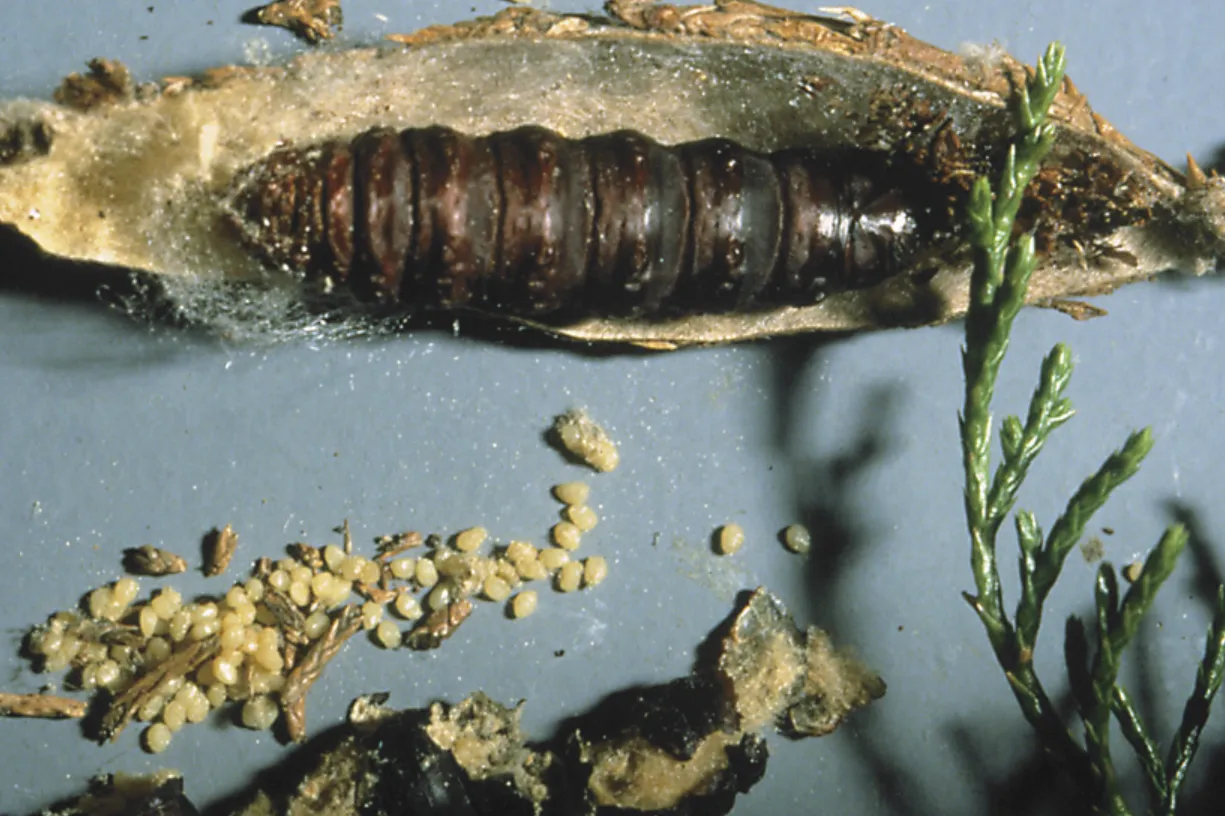
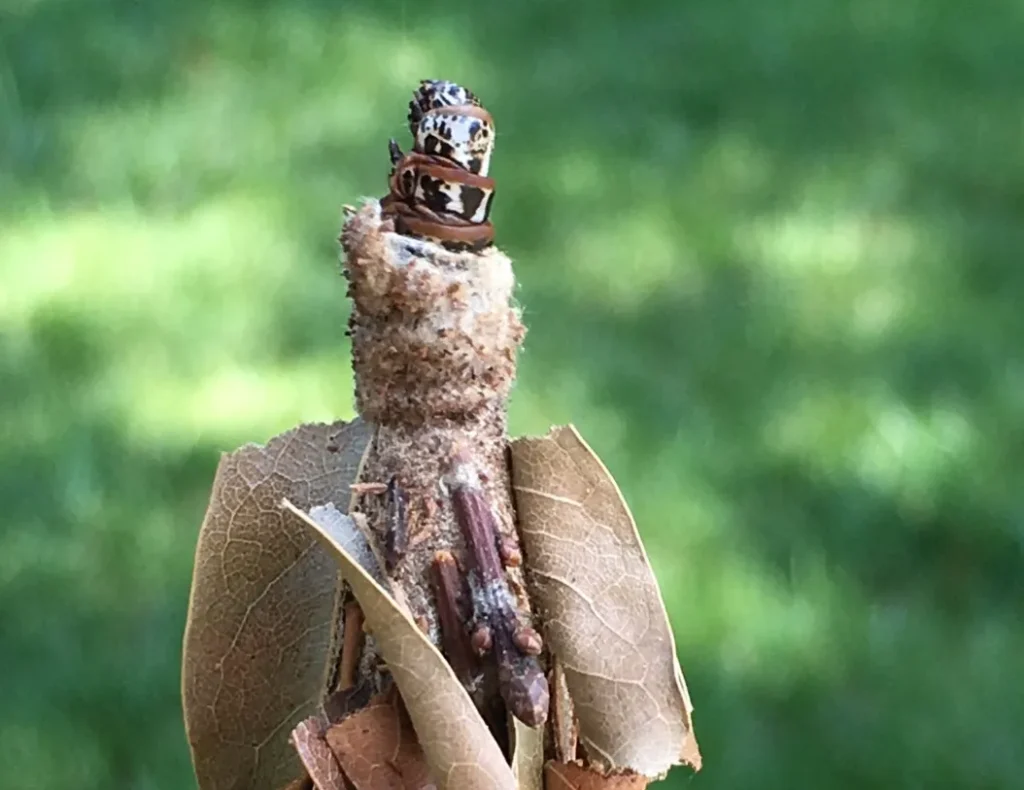
The bagworm life cycle is the complete development process of a case-making moth, most commonly the evergreen bagworm or common bagworm known scientifically as Thyridopteryx ephemeraeformis. Bagworms are not worms in the true sense; they are the larval stage of moths in the family Psychidae. Their most recognizable feature is the hanging “bag” or protective case made from silk, leaves, twigs, bark pieces, and other plant material.
A typical outdoor bagworm moth has four life stages: egg, larva, pupa, and adult. In many regions of North America, eggs overwinter inside the old female bag, hatch in late spring or early summer, feed through summer, pupate in late summer, and become adult moths by late summer or fall.
The damaging stage is the bagworm moth caterpillar, because it feeds on foliage while carrying and enlarging its bag. Heavy infestations can damage or even kill ornamental trees and shrubs, especially arborvitae, juniper, cedar, pine, and other evergreens.
Q: What is a bagworm?
A: A bagworm is the caterpillar stage of a moth that lives inside a portable silk bag covered with plant debris.
Q: How long does the bagworm life cycle take?
A: The common outdoor bagworm life cycle usually takes about one year because most species have one generation annually.
Q: Which stage causes plant damage?
A: The larval stage causes damage because the caterpillars chew leaves and needles while growing inside their protective bags.
Quick Life Cycle Table
| Stage | What Happens | Common Timing | Key Sign |
| Egg | Eggs stay inside the old female bag | Winter to spring | Brown hanging bags on twigs |
| Larva | Caterpillars hatch, feed, and build bags | Late spring to summer | Small moving bags on leaves |
| Pupa | Mature larva seals the bag and transforms | Late summer | The bag is fixed tightly to the twig |
| Adult | Male moth flies; female stays inside the bag | Late summer to fall | Male moths near infested plants |
Timing changes by climate, temperature, and species. For example, extension sources report hatching around May to June in many U.S. regions, while pupation often occurs in August or September.
Important Things That You Need To Know
Before studying the bagworm life cycle, it is important to understand that the term “bagworm” refers to multiple insects. The true outdoor bagworm moth usually refers to moths in the family Psychidae, especially Thyridopteryx ephemeraeformis, the evergreen bagworm. These insects mainly live on trees and shrubs and can become serious defoliators.
The plaster bagworm, however, is commonly used for the household casebearer, Phereoeca uterella, which belongs to the family Tineidae, not Psychidae. It is often found indoors on walls, closets, ceilings, and storage areas. Its larvae also carry a case, but they usually feed on old spider webs, lint, and organic debris, and sometimes on wool.
The term “bagworm control” usually refers to managing the outdoor pest on ornamental plants. The best timing for control is when larvae are young and actively feeding, because mature larvae are harder to treat. Hand-picking old bags during fall, winter, or early spring can reduce next year’s population.
A bagworm treatment plan should be careful and targeted. The goal is not to destroy every moth in nature, but to protect valuable plants while reducing unnecessary pesticide use. Understanding the difference between plaster bagworm, evergreen bagworm, bagworm moth, and bagworm moth caterpillar helps homeowners choose the right response.
The History of Their Scientific Naming, Evolution, and Origin
Scientific Naming of Bagworm
The commonly discussed outdoor bagworm is Thyridopteryx ephemeraeformis, described by Haworth in 1803. It belongs to the order Lepidoptera, the same insect order that includes butterflies and moths, and the family Psychidae, a group known for larvae that live inside bags.
Meaning Behind the Bagworm Name
The common name “bagworm” comes from the insect’s habit of building a protective case, or “bag.” This bag is made of silk and covered with plant fragments, bark, leaves, or other nearby materials. Because the larva carries the case while feeding, the bag becomes both a shelter and camouflage.
Evolutionary Adaptation
The bag is an important evolutionary defense. It helps protect the soft-bodied caterpillar from predators, weather, and disturbance. Many species of Psychidae also have flightless adult females, another unusual adaptation in the evolution of moths.
Origin and Distribution
The evergreen bagworm moth is widely reported across the eastern United States, extending westward into Nebraska and Texas. The broader family Psychidae occurs widely across the Americas and other parts of the world.
Their Reproductive Process, Giving Birth And Rising Their Children
Mating Begins After Pupation
The reproductive process begins after the larva completes feeding and pupates inside the bag. The adult male emerges as a dark, winged moth and flies to find a female. The female usually remains inside her bag and does not fly.
Female Bagworms Stay Inside the Bag
In Thyridopteryx ephemeraeformis, the adult female is very different from the male. She is wingless, soft-bodied, and remains protected inside the larval case. In many species, she has reduced adult features and becomes almost an egg-filled reproductive form.
Egg Production
After mating, the female lays hundreds of eggs inside the old pupal case within the bag. Different sources report ranges such as 200–1,000 eggs, 300–1,000 eggs, or 500–1,000 eggs, depending on region, species, and observation.
No Parental Care Like Mammals or Birds
Bagworms do not raise their young in the way mammals or birds do. The female’s main role is to protect the egg mass by leaving it inside the strong bag. The eggs overwinter there and hatch the following spring, starting a new generation.
Stages of the Bagworm Life Cycle
1. Egg Stage
The egg stage begins after the female deposits eggs inside her bag. These eggs remain protected through winter. The bag stays attached to twigs, stems, fences, or nearby structures. Because the eggs are hidden inside the old bag, many homeowners do not realize that each hanging bag may contain hundreds of future larvae.
2. Larval Stage
The larval stage is the most active and damaging part of the bagworm life cycle. Tiny larvae hatch and may crawl or balloon on silk threads to nearby plants. Once they find a host, they begin feeding and building a small bag around their bodies. As they grow, they enlarge the bag with silk, leaves, needles, bark, and frass.
3. Pupal Stage
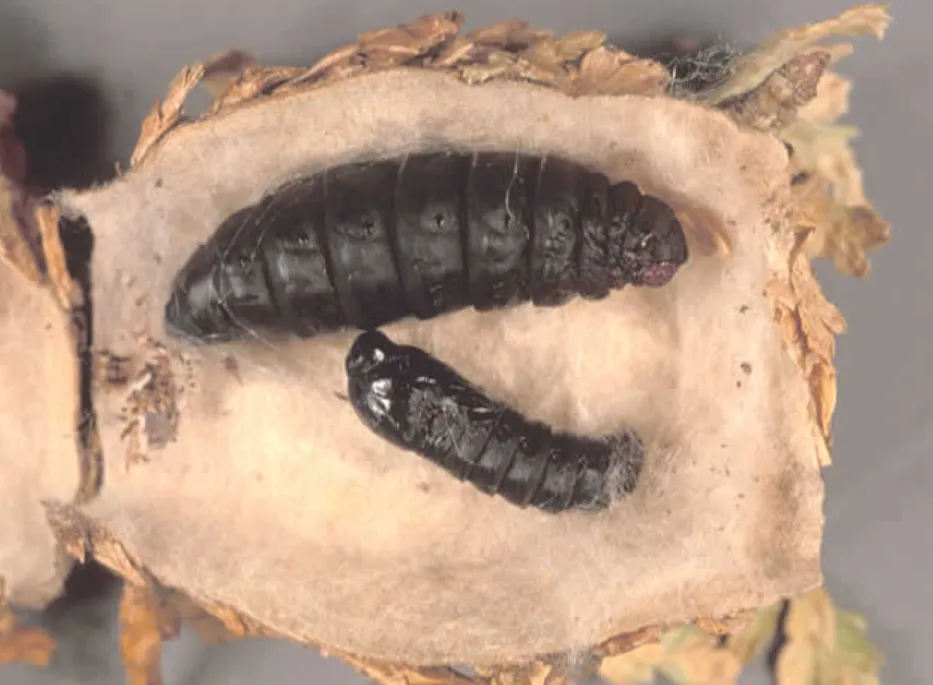
By late summer, mature larvae stop feeding and attach their bags tightly to a twig or branch using strong silk. They seal themselves inside and transform into pupae. During this stage, the insect changes from a caterpillar into an adult moth.
4. Adult Stage
The adult male bagworm moth emerges and flies to locate females. The adult female usually remains inside the bag and mates there. Adults do not feed, and their main purpose is reproduction. After mating and egg-laying, the female dies, and the eggs remain inside the bag until the next spring.
Their main diet, food sources, and collection process are explained
The main diet of outdoor bagworm moth caterpillars is plant foliage. They chew leaves, needles, and tender plant parts while carrying their bags. The common evergreen bagworm is especially associated with ornamental trees and shrubs.
Important food sources include:
- Arborvitae
- Juniper
- Cedar
- Pine
- Spruce
- Red cedar
- Maple
- Sycamore
- Locust
- Linden
- Other deciduous and evergreen trees
Some sources report that bagworms can feed on a wide range of hosts, including many tree and shrub families. Iowa State notes reports of feeding on more than 128 kinds of trees and shrubs, while UF/IFAS states that Thyridopteryx ephemeraeformis can feed on over 50 plant families.
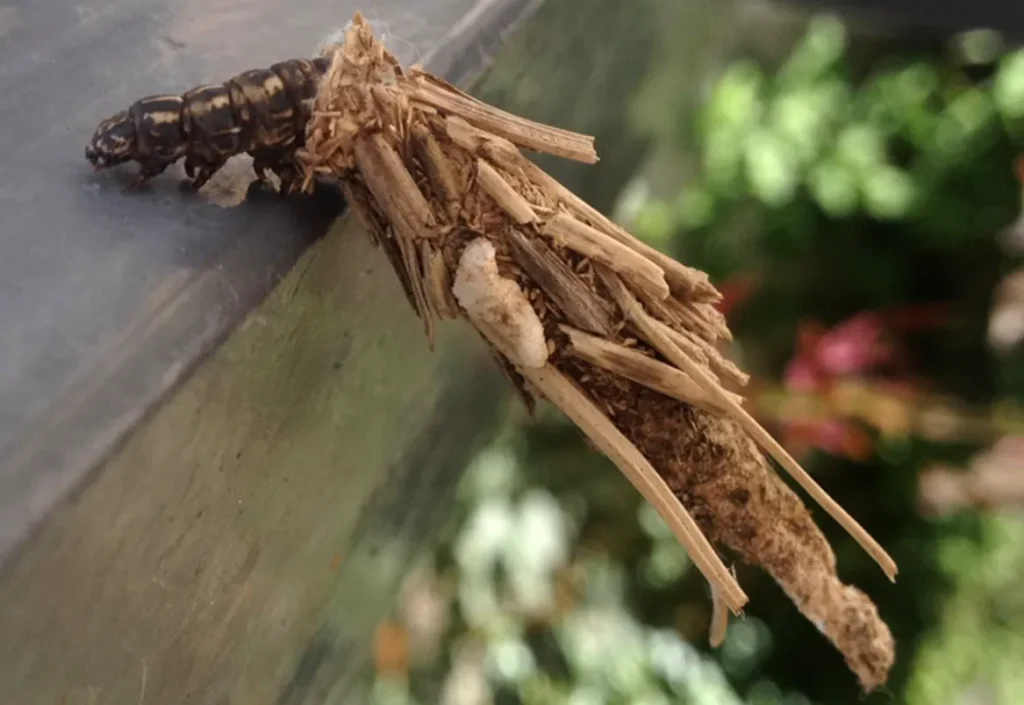
The food collection process is simple but effective. The caterpillar extends its head and legs from the top opening of the bag, chews foliage, and then retreats into the bag when disturbed. It also adds pieces of the host plant to the outside of its case, which makes the bag match the plant it is feeding on.
For the plaster bagworm, the diet is different. Indoor larvae commonly feed on old spider webs, organic debris, and sometimes wool materials, which is why sanitation and vacuuming are important for control.
How Long Does A Bagworm Live
The life of a bagworm depends on the species, climate, and whether we are talking about the whole life cycle or only the adult moth stage. For the common outdoor evergreen bagworm, the complete life cycle typically lasts about 1 year because there is usually 1 generation per year.
- Egg stage: Eggs are laid inside the female’s bag and remain there through winter. This protected egg stage can last several months until spring or early summer hatching.
- Larval stage: The larva feeds for most of the warm season. It hatches small, builds a tiny bag, and gradually enlarges it as it grows.
- Pupal stage: The pupal stage often lasts a few weeks. Texas A&M notes that after caterpillars pupate in August or September, adults may emerge after about a three-week pupal period.
- Adult male stage: The adult male lives for a very short time. UF/IFAS reports that male adults may live for only 1 to 2 days. Their main role is to fly and find females.
- Adult female stage: The female may live longer than the male, but remains inside the bag. UF/IFAS reports that the female may live for a couple of weeks.
- Indoor plaster bagworm: The plaster bagworm life cycle can be much shorter under warm indoor conditions. UF/IFAS reports an average egg-to-adult cycle of about 74.2 days, with a range of 62 to 86 days, under observed non-air-conditioned room temperature conditions in Panama.
So, when people ask, “How long does a bagworm live?” the best answer is: the outdoor bagworm life cycle often spans one year, but the adult moth stage is very brief.
Bagworm Life Cycle Lifespan in the Wild vs. in Captivity
Lifespan in the Wild
In the wild, the common bagworm usually follows a seasonal cycle. Eggs overwinter in the old female bag, larvae hatch in spring or early summer, feed through summer, pupate in late summer, and reproduce before the next generation overwinters as eggs. This creates a one-generation-per-year pattern in many regions.
Wild survival depends on host plants, weather, predators, parasitoids, and human control. Larvae in protected ornamental landscapes may survive well because fewer natural enemies are present in some urban habitats. Ohio State notes that known predators and parasites may not always provide enough control in urban settings.
Lifespan in Captivity or Indoor Conditions
In controlled or indoor conditions, development can be faster for case-bearing species such as the plaster bagworm. The household casebearer can complete development in about two to three months under warm room-temperature conditions, based on UF/IFAS life-cycle data.
For outdoor Thyridopteryx ephemeraeformis, captivity is less commonly discussed for homeowners because it is mainly a landscape pest. However, temperature, food quality, and humidity can strongly affect insect development.
Importance of the Bagworm Life Cycle in this Ecosystem
Part of the Food Web
Even though bagworms are often treated as pests, they are still part of the ecosystem. Larvae and moths can serve as food for birds, predatory insects, parasitoids, and other natural enemies. Their presence supports biodiversity, especially when populations remain balanced.
Natural Plant-Pruning Pressure
At low population levels, leaf-feeding insects like bagworms are part of natural plant-herbivore interactions. They remove some foliage and contribute to the movement of plant material through the food chain. The problem begins when populations become dense, resulting in severe defoliation.
Indicator of Landscape Imbalance
A large bagworm outbreak can indicate that a landscape has vulnerable host plants, limited predator diversity, or repeated planting of the same species. Heavy infestations are especially damaging to evergreens because many conifers do not quickly replace lost foliage.
Role in Decomposition for Plaster Bagworms
The plaster bagworm has a different ecological role indoors and around buildings. Its larvae may feed on spider webs, lint, and organic debris, helping break down small bits of organic material, although it can become a nuisance pest when populations grow indoors.
What to do to protect them in nature and save the system for the future
Use Targeted Control, Not Unnecessary Killing
- Manage bagworm control only when populations are damaging valuable plants.
- Avoid spraying just because a single bag is visible.
- Focus treatment on young larvae rather than broad pesticide use.
Encourage Natural Enemies
- Plant a variety of flowering plants to support beneficial insects.
- Avoid routine insecticide spraying, as it may harm predators and parasitoids.
- Keep landscapes biologically diverse.
Hand-Pick Bags When Practical
- On small trees and shrubs, remove old bags by hand before eggs hatch.
- Destroy removed bags properly instead of dropping them under the plant.
- Cut the silk band carefully so it does not girdle branches.
Protect Native Habitat
- Preserve mixed plant communities rather than planting only one host species.
- Healthy ecosystems reduce the chance of severe pest outbreaks.
- Native shrubs, trees, and flowers support more balanced insect populations.
Use Safer Bagworm Treatment Options First
- For young larvae, products such as Bacillus thuringiensis are commonly recommended by extension sources because they are more targeted when caterpillars are actively feeding.
- Always follow the product label and local guidance.
Fun & Interesting Facts About Bagworm Life Cycle
- Bagworms are moths, not true worms.
- The bag is made from silk and nearby materials such as leaves, needles, bark, and frass.
- Each caterpillar makes and carries its own bag.
- A young bagworm bag may be only about 1/8 inch long, but mature bags may reach 1–2 inches, depending on the species and region.
- Female evergreen bagworms usually do not fly.
- Male bagworm moths can fly but live only briefly as adults.
- The female may lay hundreds of eggs inside the old bag.
- Young larvae can spread by “ballooning” on silk threads carried by the wind.
- The bag’s appearance changes depending on the host plant because the caterpillar decorates it with local plant material.
- Plaster bagworms are often found indoors, but they are not the same family as the outdoor evergreen bagworm.
Frequently Asked Questions (FAQs)
Q: What is the full bagworm life cycle?
A: The full bagworm life cycle includes egg, larva, pupa, and adult. The outdoor common bagworm usually completes one generation per year.
Q: When do bagworms hatch?
A: In many North American regions, bagworm eggs hatch in late spring or early summer, often around May or June, depending on temperature and location.
Q: What is the best bagworm treatment?
A: For light infestations, hand-picking old bags before hatching is effective. For active larvae, treatment is most effective when caterpillars are small and feeding.
Q: Are plaster bagworms the same as evergreen bagworms?
A: No. Plaster bagworm usually refers to the household casebearer, Phereoeca uterella, in the family Tineidae. The evergreen bagworm is Thyridopteryx ephemeraeformis in the family Psychidae.
Q: What do bagworms eat?
A: Outdoor bagworms eat foliage from many trees and shrubs, especially evergreens such as arborvitae, juniper, cedar, pine, and spruce. Plaster bagworms often feed on spider webs, lint, and organic debris indoors.
Conclusion
The bagworm life cycle is a fascinating example of insect adaptation. From hidden overwintering eggs to mobile silk-covered larvae, sealed pupae, and short-lived adult moths, every stage is designed for survival. The most important stage for homeowners is the bagworm moth caterpillar, which causes plant damage as it feeds and enlarges its protective bag.
Understanding the difference between evergreen bagworm, plaster bagworm, and general bagworm moth behavior helps you choose the right response. Outdoor infestations should be managed early, especially before larvae mature and become harder to control. At the same time, bagworms are part of the natural food web, so control should be targeted, careful, and environmentally responsible. A balanced approach protects trees, supports biodiversity, and keeps the ecosystem healthier for the future.
Also Read: grain moth life cycle







Top adult platforms provide premium content ffor mature audiences.
Explore secure hubs for quality and privacy.
Here is my website … buy viagra online